By the Resource Erectors Research Team
The Era of the Interconnected Plant
In 2026, manufacturing technology is no longer defined by isolated digital initiatives or siloed pilot programs. Instead, modern factories and heavy industrial plants are utilizing highly interconnected, sensor-driven operating models to actively combat unprecedented supply chain volatility and bridge deep, structural talent gaps.
The industrial sector has officially moved past the trial phase of digital transformation; today, long-term operational success belongs entirely to enterprises that can seamlessly integrate artificial intelligence (AI), generative design, collaborative robots (cobots), and real-time digital twin environments into a cohesive, responsive production ecosystem.
For decades, the manufacturing playbook relied on predictable logistical networks and an abundant supply of skilled manual labor. However, compounding demographic shifts, evolving workforce expectations, and volatile raw-material corridors have disrupted those legacy frameworks.
Industrial leaders are no longer just buying machines to increase volume; they are deploying unified digital architectures designed to make their operations profoundly resilient. This comprehensive Resource Erectors breakdown explores the core technological pillars reshaping the industrial floor this year and establishing the baseline for competitiveness in the decade to come.
1. Predictive and Generative AI at the Operational Core
Artificial intelligence has matured from a speculative, back-office analytical utility into a critical, plant-floor operational co-pilot. In 2026, heavy manufacturing operations rely on industrial AI frameworks to synthesize massive streams of telemetry data and generate automated, high-velocity decisions.
Optimizing Production Lifecycles in Real Time
Rather than relying on static historical schedules, modern AI engines process millions of concurrent data points from edge computing sensors. These systems monitor continuous variables such as vibration harmonics, motor torque, thermal fluctuations, and acoustic signatures.
By analyzing these streams in real time, the AI can make micro-adjustments to machinery speeds, chemical feed rates, and hydraulic pressures. This continuous optimization maximizes throughput, reduces micro-stoppages, and proactively prevents catastrophic component failures weeks before a human operator would notice any structural variance.
Deploying Advanced Generative Design
The integration of generative design software is revolutionizing the initial phases of the manufacturing value chain. Instead of human engineers spending months manually iterating prototypes, they input baseline parameters directly into an AI design core. These inputs include specific performance criteria, geometric constraints, physical load expectations, and material costs.
The generative system then evaluates thousands of metallurgical and structural configurations in minutes, yielding highly optimized, organic geometries that minimize raw material volume while enhancing structural integrity. This allows plants to manufacture lighter, stronger, and less resource-intensive parts, significantly lowering carbon footprints and energy costs, and reducing component wear and tear before physical production ever begins.
2. Advanced Cobots Bridging the Talent Gap
The structural workforce deficit remains a severe bottleneck across heavy industry, infrastructure, and heavy manufacturing. To maintain production velocity amid a dwindling pool of specialized trade labor, companies are scaling up the deployment of next-generation collaborative robots—popularly known as cobots.
Safe, Proximity-Aware Execution
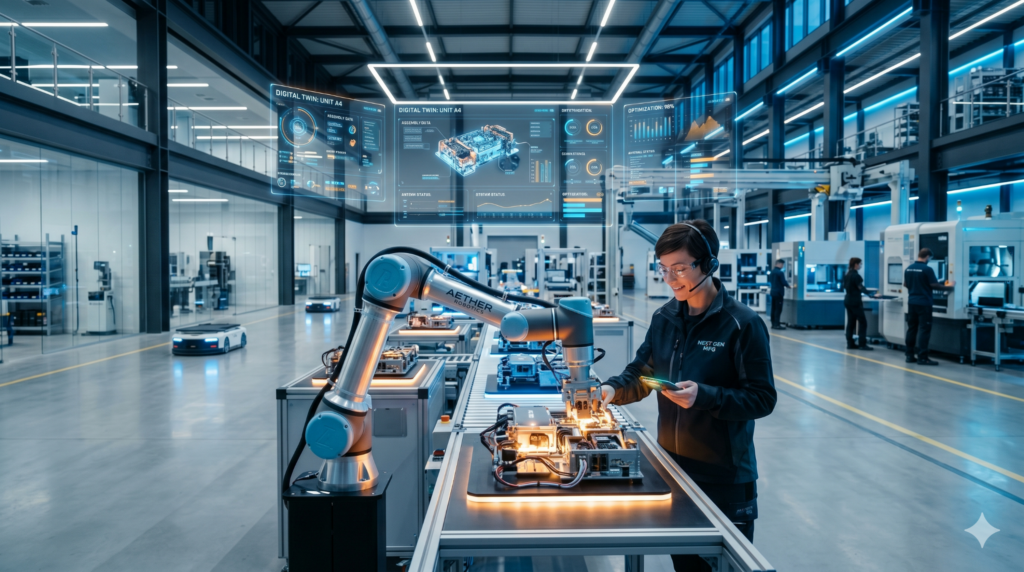
Unlike legacy industrial robots that required heavy, light-curtained safety enclosures to protect human workers from blunt-force trauma, 2026’s cobots are engineered for safe, side-by-side execution.
Equipped with high-resolution spatial sensors, computer vision, and advanced torque-limiting feedback mechanisms, these machines instantly sense human proximity or unexpected resistance. If a technician steps into a cobot’s operational path, the machine dynamically slows its velocity or halts its movement entirely, completely mitigating the risk of workplace injury and eliminating physical layout barriers on the floor.
Ergonomic and High-Precision Relief From Hazardous Tasks
The true value of coboting lies in task allocation. Cobots are strategically deployed to absorb repetitive, ergonomically punishing, or chemically hazardous tasks. Applications such as continuous high-precision welding, heavy sub-assembly manipulation, uniform adhesive dispensing, and non-destructive testing are increasingly assigned to robotic arms.
By offloading these physically exhausting routines, human operators are insulated from chronic workplace strain and industrial hazards. Crucially, this frees up the existing, highly valued human workforce to step into elevated roles centered around complex equipment troubleshooting, system integration, quality assurance, and high-level facility management.
3. Living, Real-Time Digital Twin Environments
The concept of the digital twin has evolved dramatically from a static, post-facto 3D computer-aided design (CAD) file into a living, breathing virtual replica of the physical plant environment. These environments, driven by dense, ultra-low-latency Internet of Things (IoT) sensor arrays and high-speed industrial networks, provide operational visibility that bridges the gap between field execution and managerial oversight.
Live Operational Simulation and Stress Testing With Zero Risk
Modern digital twins allow plant managers to perform live operational simulations with zero risk to physical assets. Before executing a major line changeover, modifying conveyor speeds, or introducing a new product run, supervisors simulate the entire process virtually.
The digital twin analyzes how the adjustment will ripple through upstream material supply chains and downstream packaging loops. This predictive modeling identifies unexpected physical bottlenecks, thermal loads, or mechanical stress points, allowing engineers to iron out flaws virtually and achieve seamless, first-time-right implementation on the actual production line.
Dynamic Supply Chain Synchronization
In 2026, internal plant logistics cannot be decoupled from external supply chain realities. Living digital twin platforms are integrated directly into supplier logistics APIs. When a freight delay occurs, or a raw material shipment is disrupted by geopolitical or weather events, the digital twin automatically recalculates optimal operational configurations.
It can re-sequence plant-floor production to favor alternative components currently in inventory, minimizing idle times and insulating the facility’s bottom line from broader macroeconomic volatility.
4. The Unified Data Thread: Cybersecurity and Edge Computing
As heavy manufacturing assets become increasingly sensor-driven and interconnected, the volume of data generated on the plant floor has grown exponentially. Processing this data purely via centralized cloud servers introduces latency, bandwidth bottlenecks, and heightened security risks.
Consequently, the industry is shifting toward robust edge-computing architectures.
By processing time-sensitive telemetry directly at the machine level, plants can execute instantaneous safety shutdowns or operational course corrections without waiting for cloud validation.
Concurrently, this hyper-connected landscape demands specialized, industrial-grade cybersecurity frameworks. Operational Technology (OT) security systems are being overhauled with zero-trust network architectures, ensuring that as AI engines and digital twins hook into physical machinery, critical infrastructure remains insulated from external cyber threats.
Conclusion: Engineering Resilience into the Industrial Asset Base
The accelerating shift in manufacturing technology isn’t simply about deploying isolated pieces of advanced hardware or adopting temporary software solutions; it is about establishing a permanent foundation of structural resilience.
By weaving together the cognitive power of predictive AI, the tactile agility of advanced cobotics, and the macro-level visibility of real-time digital twins, forward-thinking industrial operations are creating highly adaptive environments.
These facilities are uniquely capable of adapting to market shocks, labor shortages, and supply chain changes in real time, turning technological adoption into a definitive, long-term competitive advantage.
Time to Partner with Resource Erectors
At Resource Erectors, we know that integrating cutting-edge safety technology and advanced automation software requires a forward-thinking workforce. We specialize in connecting top-tier heavy-industry companies with elite professionals who understand how to leverage modern, data-driven operational standards.
- For Employers: If your operation needs to fill crucial positions such as safety directors, plant managers, or maintenance supervisors who can lead digital transformations, browse our industry-leading recruitment services.
- For Professionals: If you are a professional seeking to manage your long-term success with organizations at the forefront of industrial innovation, explore our available careers and open Resource Erectors job opportunities.
- Get on the Short List: To put yourself on CEO Dan’s short list for confidential, elite opportunities that never appear on public job boards, we highly encourage you to submit your resume for general consideration today.
To discuss your company’s specific workforce needs or to start your career journey, visit our contact page today.