By the Resource Erectors Research Team
The blueprint of modern industrial execution is changing. To counter tight schedules and a persistent structural labor shortage, the heavy industrial, mining, and civil sectors are moving their operations off the job site and onto the factory floor. Whether it is a pre-assembled modular processing skid for an aggregate plant, a multi-ton structural precast wall assembly, or a fully integrated electrical control module, modular manufacturing is setting a new baseline for speed and efficiency.
However, shifting your construction project into a controlled manufacturing setting does not eliminate risk. It simply changes its zip code.
In a traditional stick-built or field-poured project, risk management is relatively straightforward. Your assets are static. They sit securely behind a fenced perimeter, and your risk exposure moves slowly, step by step, in tandem with the physical progress of the build.
Conversely, heavy modularity creates a highly volatile, fluid risk profile. Your most valuable assets are suddenly exposed to highway transit forces, off-site factory bankruptcies, complex design coordination issues, and high-consequence crane lifts. If your risk management strategy and insurance underwriting protocols are still relying on traditional, legacy construction boilerplate, you are exposing your firm to massive, unhedged financial liabilities.
To protect your margins and insulate your backlog, industrial leaders must learn to manage modular construction risk management across the entire lifecycle of off-site manufacturing, transit, and final field assembly.
1. The Capital Cash-Flow Inversion and Factory Storage Blindspots
In traditional heavy construction, financial risk moves backward. An owner or general contractor pays a subcontractor in arrears based on verified progress in the field, such as cubic yards of concrete poured or tons of structural steel erected. If a subcontractor defaults, the physical materials are already anchored to the real estate, legally protecting the buyer.
Heavy modularity flips this entire cash-flow model on its head. Fabricators require massive, front-loaded capital injections to secure raw steel, complex piping runs, and production line capacity months before a single component rolls onto the active job site.
| Construction Attribute | Traditional Field Erection | Heavy Off-Site Modularity |
| Payment Structure | Paid in arrears based on field verification | Heavy upfront capital deposits required |
| Asset Location | Secured entirely within the fenced project site | Distributed across distant fabrication plants |
| Primary Risk Phase | Field execution and weather dependencies | Logistics, transit loads, and assembly tolerances |
| Property Custody | Direct ownership attached to the real estate | Complex custody split on third-party floors |
This creates a severe underwriting vulnerability if your fabricator is building your industrial modules in a facility hundreds of miles away alongside components destined for other projects. Standard Builders Risk insurance policies are strictly tied to the geographic coordinates of your active job site. Consequently, if that distant manufacturing plant burns down, suffers a catastrophic theft, or faces a sudden corporate bankruptcy, a standard baseline policy will reject the claim entirely.
The Contractual Fix
To close this coverage gap, project negotiators must implement explicit Designated Location Off-Site Storage Riders directly into their insurance matrix. Furthermore, you must secure legal title to the raw materials early via UCC-1 filings.
This legal attachment ensures that even if the fabricator faces an abrupt insolvency, the materials belong to you, preventing them from being seized by third-party liquidators. Field teams should also enforce strict material segregation protocols, requiring the manufacturer to house your components in clearly marked, fenced, and dedicated zones on the shop floor.
2. The In-Transit Inversion: Engineering for 60 MPH
Once a heavy industrial module or precast structural element leaves the factory floor, it enters the most physically dangerous phase of its entire lifecycle: highway or maritime transit.
When an industrial asset is built on-site, it is engineered to sustain static, vertical loads. However, when that same asset is loaded onto a multi-axle heavy-haul transport rig or a marine barge, it faces entirely different physical vectors. It is subjected to hours of high-frequency road vibrations, intense lateral wind shear, and multi-directional torsional twisting as the transport vehicle navigates public highways.
If a module experiences minor structural shifting or micro-fracturing during transit, it may look perfectly intact when it arrives at the project gate. But if the internal structural frame has twisted by even a fraction of an inch, the module will fail to seat onto the site foundations. At that exact moment, your field operations grind to a dead halt, and your Tier-1 crawler cranes start burning through thousands of dollars an hour in idle standby costs.
The Contractual Fix
Traditional transit riders attached to basic property insurance are completely inadequate for heavy industrial modularity. Instead, logistics teams must secure specialized Inland Marine (or Ocean Marine for barge transit) insurance that includes a comprehensive “Constructive Total Loss” clause.
This specific underwriting language ensures that if a module loses its precise dimensional alignment during transit—rendering it un-installable without a full factory teardown—the insurer covers the cost of a complete replacement, rather than just patching visible surface damage.
3. The Assembly Clash and the Latent Defect Liability Loop
When a field installation fails because an off-site module doesn’t align with on-site foundations, a multi-million dollar blame game erupts immediately. The fabricator insists they built precisely to the shop drawings. The foundation subcontractor swears their anchor bolts are perfectly plumb to the civil survey. The structural engineer claims that the field crew used improper rigging techniques during the crane lift, resulting in a structural warp.
This legal and insurance gridlock occurs because traditional project structures separate design liability from manufacturing execution. When these responsibilities are fragmented, standard Commercial General Liability (CGL) policies will often deny claims, categorizing the failure as a professional design error or an uncovered business dispute rather than an occurrence of property damage.
The Industry 5.0 Solution
To bypass this structural fragmentation, forward-thinking industrial builders are taking a page out of the Industry 5.0 manual. Much like the advanced, vertically integrated manufacturing technology trends pioneered by heavy aerospace leaders like SpaceX, modern construction projects are unifying design and fabrication data into a single, collaborative ecosystem.
By utilizing high-bandwidth networks, field teams deploy continuous laser scanning to construct a live Digital Twin of the project site. This spatial data is fed back instantly to the fabrication plant, verifying that the concrete foundation as-builts match the manufacturing tolerances of the module shop jigs down to the millimeter before the component ever leaves the factory floor.
From an underwriting perspective, this technological integration must be backed by a specialized Contractors Professional Liability (CPrL) policy coupled with Products-Completed Operations Liability coverage. This unified framework insures the entire system, preventing the insurer from dodging claims by trying to separate a “design flaw” from a “manufacturing defect.”
4. The Passing of Risk: Defining the “Lifting Hook” Rule
The absolute centerpiece of your modular risk strategy must be a crystal-clear, unambiguous definition of the exact second at which custody, ownership, and risk of loss transfer from the manufacturer to the field constructor. Relying on basic commercial freight terms like FOB Destination or FOB Shipping Point is an invitation to a litigation nightmare.
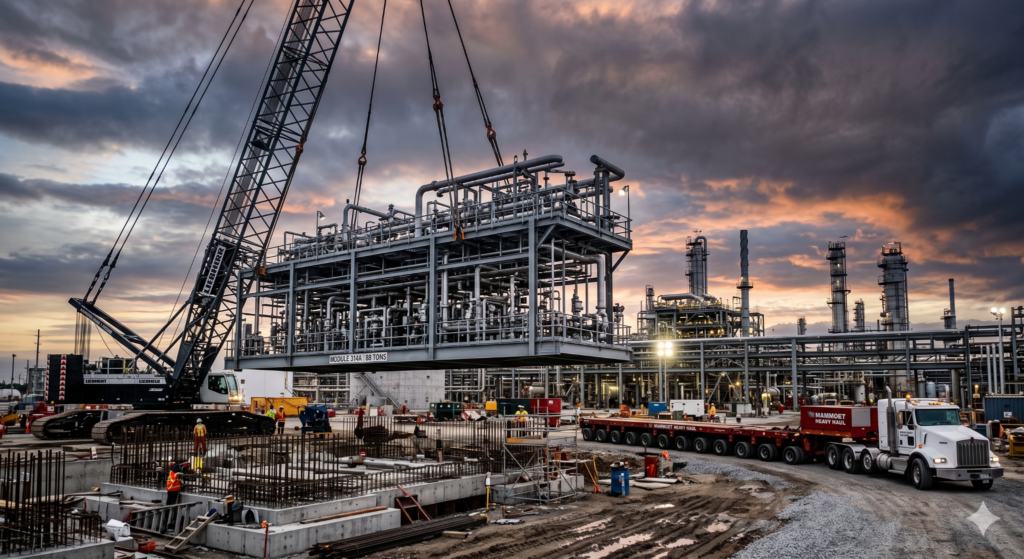
If a multi-ton mechanical skid falls during offloading or suffers a structural failure as it is being swung into position by the site crane, you cannot afford to have a grey area regarding who owned the asset at that exact microsecond.
The Contractual Fix
Sophisticated heavy industrial agreements utilize the “Lifting Hook” Rule. The contract explicitly dictates that the risk of loss remains entirely with the fabricator and their transit carrier while the vehicle is en route, enters the project gates, and parks at the designated offloading zone.
Risk of loss and physical custody shift to the general contractor or erection sub the exact microsecond the field crane’s rigging attaches to the module’s certified lifting eyes.
Before that rigging attaches, the field quality control team must have a contractually mandated inspection window to run physical and dimensional checks while the asset sits on the flatbed. Once the hooks are set and the load is lifted, the field team has officially accepted the component’s structural integrity as-delivered.
Conclusion: Adapting Risk to the Speed of Modularity
Off-site manufacturing and precast construction are revolutionizing the industrial sectors by bringing the predictability, speed, and safety of a controlled factory line to the unpredictable world of heavy construction. But you cannot deploy next-generation building methods while clinging to legacy risk management tools.
By anchoring your project contracts with precise “Lifting Hook” protocols, securing specialized Inland Marine transit protection, and utilizing Industry 5.0 digital twinning to bridge the gap between design and fabrication, you ensure that the efficiencies of modular execution are fully protected from downstream liabilities.
Build Your Future with Resource Erectors
At Resource Erectors, we have spent decades partnering with the premier organizations and top-tier talent driving America’s heavy industrial sectors. Whether you specialize in mining, aggregates, civil construction, heavy manufacturing, or engineering, we connect world-class professionals with industry-leading employers to build the future of Industry 5.0.
- Looking for your next career breakthrough? Explore our comprehensive, up-to-date Job Board to find your next professional destination.
- Ready to take the next step? You can quickly Submit Your Resume for General Consideration to stand out to our specialized recruiting team.
- Ready to solve your workforce challenges? Discover how our customized recruitment strategies help you secure elite professionals by learning more About Resource Erectors today.
References
Jones, M. K. (2022). Innovators and the development of mini-mills for steel recycling: Lessons for the development of a circular economy from the steel industry. Colorado School of Mines. https://www.mines.edu/global-energy-future/wp-content/uploads/sites/361/2022/10/Payne-Institute-Commentary-Lessons.pdf
NFP Insights. (2025). Top five modular construction risks and how to address them. NFP Insurance Brokerage & Consulting. https://www.nfp.com/insights/top-five-modular-construction-risks-and-how-to-address-them/