By the Resource Erectors Research Team
When we listen to the marketing pitches coming out of robotics venture funds, one would think civil construction sites are ready to run entirely on autopilot. The promotional images show sleek autonomous excavators, layout robots, and robotic arms operating with flawless, surgical precision against sunset horizons.
However, any engineer who has ever managed a live jobsite knows the real world is far messier than a sanitized lab or a rendered CAD model. Mud gets into sensors. Ambient humidity freezes inside “waterproof” enclosures. Extreme cold turns heavy-duty joint lubricant into thick glue.
The true metric of civil construction robot performance isn’t what a machine achieves in a controlled indoor facility. It is how well that equipment performs when it meets unscripted field conditions, sudden weather drops, and microscopic site tolerances.
Recent field data highlights this exact gap between laboratory promise and jobsite execution. In a landmark analysis published by Engineering News-Record (ENR) on what 5,000 autonomous hours in heavy industry taught us, industry researchers revealed a fundamental truth about heavy civil automation: field reality breaks spec sheets, silently fools sensors, and demands a completely new approach to human-robot collaboration.
1. The Site Will Break Your Robot’s Spec Sheet
On paper, modern construction robotics look bulletproof. Engineering teams select components based on rigorous spec sheets detailing IP ingress protection ratings, operating temperature thresholds, and vibration limits.
Yet, field conditions have a unique way of finding the fine print that lab technicians missed.
Take operating temperatures as an example. During a cold snap in Austin, Texas, an autonomous layout robot operating on an 8th-floor open slab suddenly ground to a halt. The robotic arm was built with collaborative force sensors designed to emergency-stop if it contacted a human worker or obstacle.
Nothing was touching the machine. The freezing ambient temperature had stiffened the synthetic lubricant inside the arm joints. To the internal sensors, that increased mechanical resistance felt identical to a physical collision. The robot repeatedly shut itself down in a high-risk area near the slab edge.
In another instance in Nashville, rapid cooling caused ambient humidity inside a completely sealed, waterproof chassis to condense. That moisture dripped directly onto an internal circuit board, causing a short circuit. Sealing the box kept the weather out, but it trapped moist air inside.
The takeaway for civil equipment managers is clear:
- Lab testing represents the absolute floor of performance, not the ceiling.
- “Weatherproof” enclosures must actively manage internal climate, temperature, and moisture levels.
- Field mechanical recovery protocols must be baked into every equipment deployment plan.
2. Perception Fails Silently: The Limits of LiDAR
In heavy civil and structural construction, the most dangerous equipment failure isn’t a machine that stops working. It is a machine that keeps moving because it doesn’t realize it is failing.
Most autonomous construction equipment relies heavily on LiDAR to build a 3D point-cloud map of its surroundings. LiDAR emits laser pulses and measures the time it takes for them to bounce back.
While LiDAR excels at mapping massive earthmoving cuts, open trenches, and structural concrete walls, it possesses a dangerous blind spot: thin, reflective, or curved surfaces.
During a field test, an autonomous arm nearly struck an overhead one-inch pipe. When engineers reviewed the sensor feed, the space where the pipe hung appeared completely empty. The curved, metallic surface of the pipe had reflected the laser pulses away from the receiver, allowing the obstacle to slip entirely between the discrete laser returns.
The sensor didn’t malfunction. It performed precisely to spec against an object the original software model never anticipated.
To solve this silent perception gap, leading robotics developers are fusing depth cameras with LiDAR feeds. Depth cameras resolve small structural features and thin utilities that sparse laser points miss, creating a multi-layered safety net for heavy machinery.
3. The “Human Catch” Is a System Feature, Not a Failure
There is a common misconception among technology promoters that the ultimate goal of construction robotics is 100% unmanned, zero-human operation. The real-world data completely refutes this idea.
On an active, fast-moving civil site, the human operator is not a temporary crutch waiting to be phased out. The human operator is a permanent, vital safety layer built directly into the system architecture.
When field operators hit an emergency stop to prevent a robot from striking an unseen pipe or navigating into fresh concrete, that intervention shouldn’t be logged as a failure of autonomy. Instead, it represents the system working exactly as designed.
Semi-autonomous workflows pair the tireless precision of machines with the intuitive context awareness of experienced human professionals:
- Robots handle repetitive precision: Layout marking, pile driving, high-volume trenching, and continuous grade monitoring.
- Human operators handle site context: Identifying unexpected utility line shifts, interpreting sudden weather changes, and supervising edge cases.
4. What This Means for Heavy Civil Construction Hiring in 2026
The rapid evolution of jobsite robotics is reshaping what heavy civil contractors and aggregate producers need from their technical workforce.
Deploying automated excavators, autonomous pile drivers, and layout robots does not eliminate heavy industry jobs. Instead, these technologies dramatically elevate the skill requirements for on-site personnel.
Contractors and project managers who know how to deploy semi-autonomous fleets are commanding top-tier market compensation. Operations teams now require professionals who understand both heavy civil execution and digital equipment integration:
- Field Robotics Supervisors: Specialists who can oversee semi-autonomous machinery, manage field calibration, and execute manual recovery procedures when environmental conditions push equipment past its limits.
- Systems Integration Engineers: Civil and mechanical engineers capable of bridging the gap between digital twin BIM models, sensor payloads, and heavy equipment hydraulics.
- Acoustic and Environmental Safety Directors: Leaders focused on site safety, noise attenuation, and human-machine interface protocols on busy, multi-trade jobsites.
The Resilient Takeaway for Industrial Producers
Autonomy in heavy civil construction is not a plug-and-play technology that you buy off a shelf and forget. It is an iterative, field-tested discipline that requires continuous adaptation.
The contractors and engineering firms winning the productivity race today aren’t the ones waiting for perfect, fully autonomous machines. They are the forward-thinking builders deploying semi-autonomous tools today, learning from field reality, and building the skilled teams needed to manage tomorrow’s high-tech job sites.
Ready to Elevate Your Technical Leadership Team?
As heavy civil projects grow in complexity, the demand for project managers, superintendents, and civil engineers who understand modern jobsite technology has never been higher.
When you are a heavy industry professional ready to position your career at the forefront of modern infrastructure, don’t let your resume get lost on generic job boards.
Take control of your professional growth. Submit your resume for general consideration to Resource Erectors today. This places your professional profile directly onto CEO Dan’s short list for exclusive, confidential career opportunities with top-tier industrial producers.
Time to Call Resource Erectors
At Resource Erectors, we specialize in connecting heavy civil, mining, and aggregates leaders with elite talent prepared to drive operational success.
- For Employers: When your company is scaling operations and needs specialized civil, mechanical, or structural engineering leaders who understand modern equipment integration, explore our recruitment services.
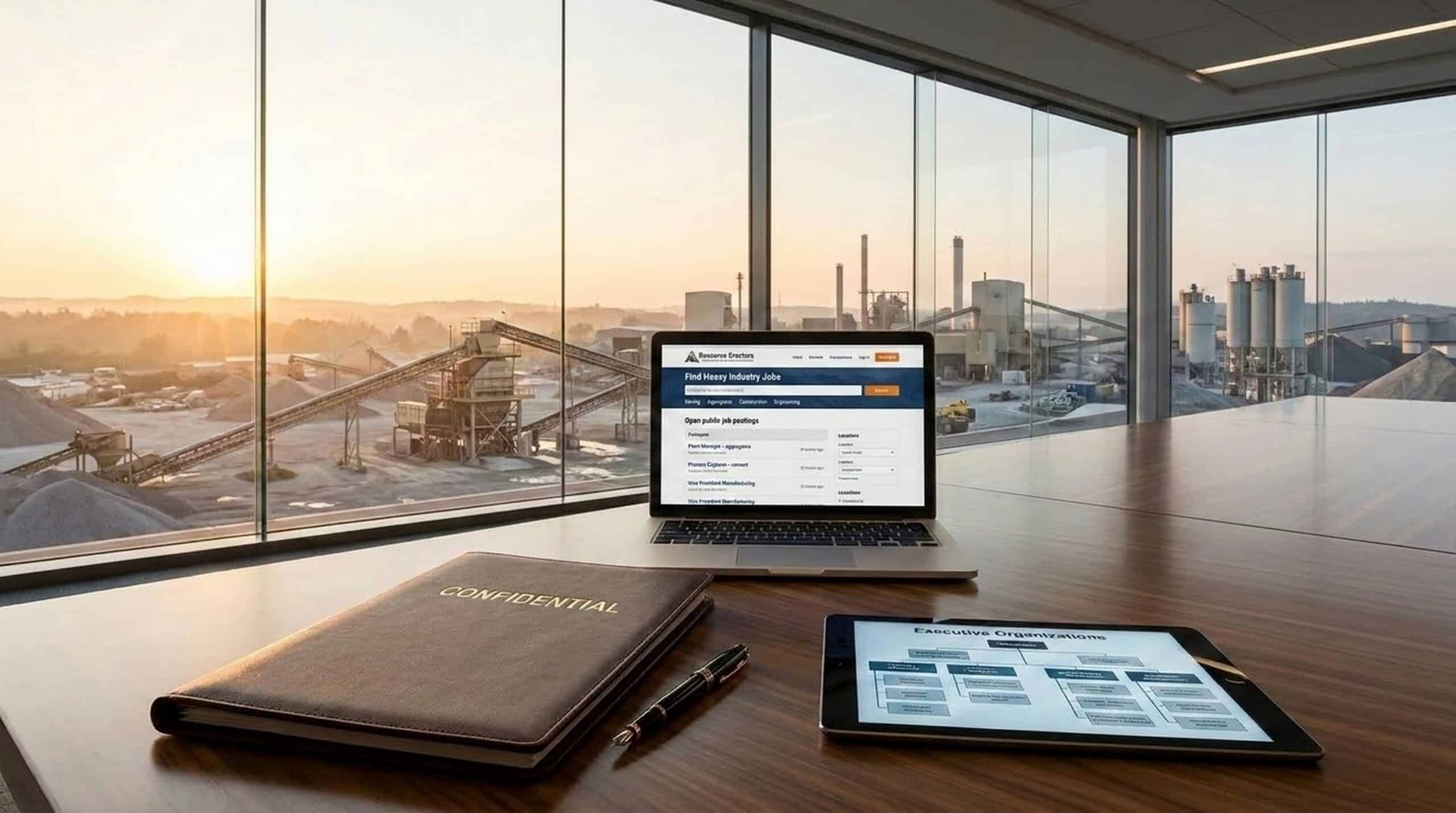
- For Professionals: When you are ready to elevate your career with industry-leading employers driving massive domestic growth, browse active listings on the Resource Erectors job board.
To secure top-tier talent or map out your next major career move, visit our contact page today.