By the Resource Erectors Research Team
When SpaceX nailed its historic Starship Flight 13 mission out of Starbase, Texas, the aerospace world erupted. Flight 13 wasn’t just another launch; it was a watershed moment for heavy industry. Pushing the newly upgraded V3 Starship architecture through a flawless high-dynamic-pressure ascent, deploying next-gen orbital payloads, and sticking an intact, controlled soft splashdown proved that hyper-heavy lift is officially operational.
Under the relentless drive of engineer CEO Elon Musk, SpaceX has turned orbital transport from a rare, multi-million-dollar government luxury into a reliable, high-frequency logistics pipeline.
For project managers, heavy civil engineers, and capital investors looking at the next decade, Starship’s success marks a permanent shift. The space sector is no longer just about exploration. It is evolving into the ultimate heavy industry frontier.
Over the next 10 years, two major commercial engines will drive off-world industrial growth: high-profit satellite deployment operations and space-based mega-data centers designed to solve Earth’s noise and thermal bottlenecks.
1. The Economics of Mass Orbital Delivery: 40% to 70% Margins
To understand why capital is flooding into off-world infrastructure, you have to follow the margins.
Historically, launch providers operated on thin, fragile margins because rockets were treated like single-use aluminum cans. Musk’s intense focus on rapid, full reusability has fundamentally rewritten the financial ledger.
When a single launch vehicle can lift over 100 metric tons to low-Earth orbit (LEO) and fly again with minimal turnaround maintenance, the unit economics shift dramatically. Today, specialized satellite deployment operations and orbital rideshare missions routinely generate net profit margins between 40% and 70% per flight.
These sky-high margins are creating a massive capital pool that aerospace firms are actively reinvesting into heavy orbital manufacturing, space-based logistics, and long-term infrastructure. Much like the early railroad booms of the 19th century, the profits generated from moving the cargo are directly funding the construction of the permanent terminals.
2. The Space Data Center Solves Earth’s Industrial Dilemma
While satellite deployment funds the immediate pipeline, the biggest strategic pivot over the next decade will be moving high-density compute clusters off the planet entirely.
On Earth, developers building mega-data centers for artificial intelligence face severe pushback. As power demands surge into gigawatt territory, local communities are resisting the non-stop noise of massive cooling banks and natural gas turbines. Furthermore, regional water tables are being strained to cool millions of heat-generating GPUs.
Placing AI training data centers in orbit eliminates these terrestrial bottlenecks:
Zero Noise and Zero Community Friction
Orbital compute hubs operate in a complete vacuum. There are no neighbors to disturb, no cooling fan whines, and no local zoning boards to battle. The acoustic and environmental footprint on Earth drops to absolute zero once the hardware leaves the launch pad.
Limitless Solar Energy and Radiative Cooling
In LEO or geostationary orbit, a data center enjoys uninterrupted, high-efficiency solar power unhindered by atmospheric scattering or nighttime cycles. Cooling is handled through radiative heat exchangers, rejecting heat directly into the extreme cold of deep space without consuming a single gallon of fresh water.
3. The 10-Year Heavy Civil & Structural Roadmap
Building off-world infrastructure requires a cross-disciplinary bridge between aerospace software and traditional heavy civil engineering. Over the next decade, we will see heavy industrial personnel stepping directly into orbital construction roles:
- 2026–2028 (Heavy Payload Scaling): Rapid deployment of modular, high-density satellite networks and orbital fuel depots using reusable Starship architecture.
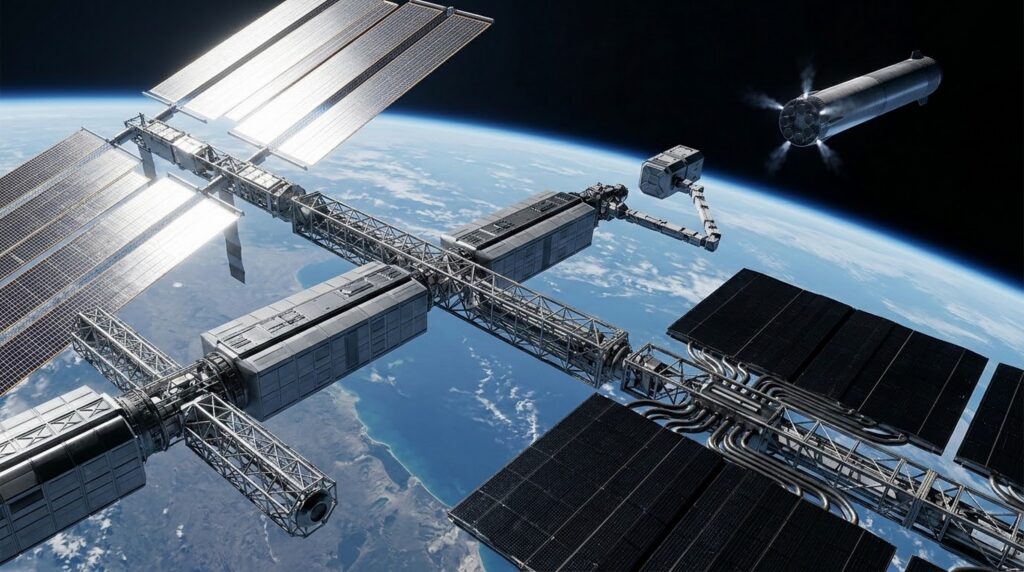
- 2028–2031 (Orbital Assembly & Foundations): Civil and structural project managers will oversee automated, space-based construction using advanced trusses, radiation shielding, and modular solar arrays to house floating compute modules.
- 31–2036 (Full Compute Offloading): The transition of energy-intensive AI model training away from terrestrial grids, turning space-based data centers into the primary engine for global computing power.
The Resilient Takeaway for Heavy Industry Leaders
The line separating heavy civil construction, energy infrastructure, and aerospace is rapidly disappearing. The same core principles that govern terrestrial mega-projects—logistics management, structural integrity, power distribution, and thermal efficiency—are the exact skills needed to build the orbital economy.
As leaders like Elon Musk push the boundaries of transport, forward-thinking industrial producers and engineering teams are preparing for a future where the horizon extends far beyond the Earth’s crust.
Ready to Lead the Next Generation of Industrial Infrastructure?
When you are building complex ground-based facilities or engineering the supply chains powering tomorrow’s high-tech infrastructure, elite technical talent is the ultimate competitive advantage.
When you are a heavy industry professional ready to position your career at the forefront of modern engineering, don’t let your resume gather dust on public job boards.
Take control of your professional trajectory. Submit your resume for general consideration to Resource Erectors today. This places your professional profile directly onto CEO Dan’s short list for exclusive, confidential career opportunities with top-tier industrial producers.
Time to Call Resource Erectors
At Resource Erectors, we specialize in connecting heavy civil, mining, and infrastructure leaders with elite talent prepared to drive operational success.
- For Employers: When your company is scaling operations and needs specialized civil, mechanical, or structural engineering leaders who understand complex industrial design, explore our recruitment services. Over 85% of Resource Erectors-placed professionals are still contributing to the success of our client companies 5 years later and counting. CEO Dan’s decades of specialized heavy industry HR experience lets you avoid the high cost of vacancies in your organization.
- For Professionals: When you are ready to elevate your career with industry-leading employers driving massive domestic growth, browse active listings on the Resource Erectors job board.
To secure top-tier talent or map out your next major career move, visit our contact page today.
For more information:
This video breaks down the key technical milestones achieved during Starship’s thirteenth orbital test flight and explains what the successful mission means for the future of heavy payload deployment.