From the Foundry Floor to Industry 5.0
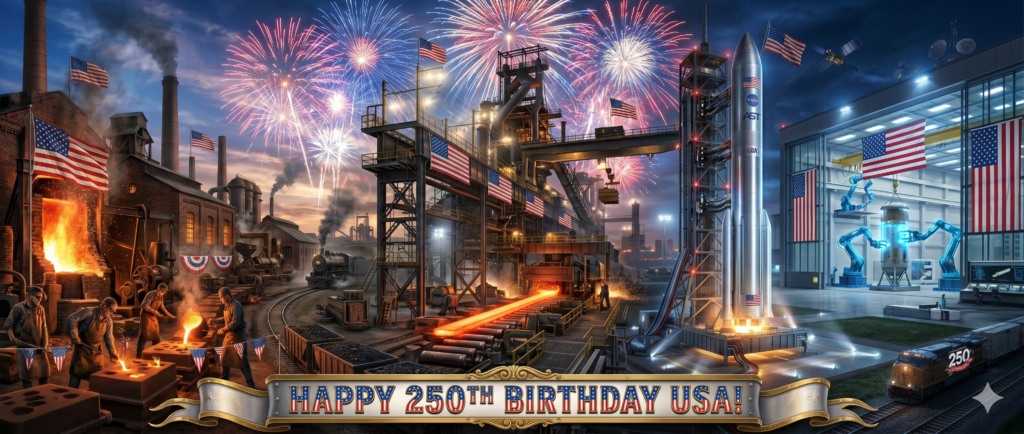
For two and a half centuries, the story of the United States has been written not just in the halls of governance, but in the grease of the machine shop, the heat of the blast furnace, the deep dark of the mine shaft, and the stark glare of the launchpad.
Every July 4th, we celebrate the political ideals of liberty and self-determination. But it was American heavy industry that forged the physical infrastructure to defend and sustain those ideals. It transformed a vast, untamed wilderness of isolated agrarian colonies into the undisputed industrial engine of the modern world.
As we cross the midpoint of 2026, the global industrial landscape is shifting beneath our feet once again. We are stepping square into the era of Industry 5.0—a hyper-technological dawn where artificial intelligence, automated heavy equipment, and human craft skill work in active harmony. It is a moment of dizzying progression. Just weeks ago, the historic NASDAQ debut of SpaceX briefly minted the world’s very first trillionaire, anchoring a capital milestone that places a single American industrialist’s paper value above the GDP of entire nations.
But this pinnacle didn’t manifest from a vacuum. It is the direct lineage of 250 years of relentless, continuous, and unapologetic industrial ambition. To understand where American heavy industry is going, we have to look back at the giants, the breakthroughs, and the sheer grit that built the foundations.
Act I: The Agrarian Foundation and the Industrial Pioneers (1776–1860)
Before the iron mills roared, America was an empire of soil, timber, and muscle. In 1776, over 90% of the American workforce was engaged in agriculture. The initial industrial challenge was simple but staggering: how do you conquer, cultivate, and connect a continent using a small, geographically scattered population?
The answer lay in mechanical leverage. The early American ethos was defined by a unique breed of self-taught polymaths who saw raw physical labor as an engineering problem waiting to be solved.
The Enlightenment Engineers
Long before he was a revolutionary statesman, Benjamin Franklin was the spiritual grandfather of American industrial ingenuity. Franklin didn’t just capture lightning with a kite; he mapped the Gulf Stream to speed up international shipping lanes, invented the efficient Franklin stove to revolutionize indoor heating, and refused to patent his designs, believing that industrial progress belonged to the public. He proved that the American mind was uniquely suited for practical, scalable physics.
| Era / Phase | Core Innovation Focus | Representative Figures |
| Enlightenment Foundation (Pre-1800) | Applied Physics & Public Utility | Benjamin Franklin |
| Early Mass Production (1800–1860) | Interchangeable Parts & Automation | Eli Whitney |
| The Power Grid Era (1880–1900) | Centralized Utilities & Distribution | Thomas Edison, Nikola Tesla |
| The Modern Era (2010–2026) | Collaborative Automation & Aerospace | Elon Musk |
Following the Revolution, the nascent nation needed to manufacture its own independence. In 1793, Eli Whitney’s cotton gin mechanically automated the separation of seeds from fiber, radically scaling agricultural output. Simultaneously, the concept of interchangeable parts, pioneered by Whitney and perfected in federal armories like Springfield and Harper’s Ferry, laid the early blueprint for modern mass production.
Digging the Wealth of the Earth
True heavy industry requires raw input: fuel and ore. By the 1820s, the discovery of massive anthracite coal deposits in Pennsylvania shifted the young nation off timber and onto a high-energy-density fuel source.
To move this raw material from the mountains to the coastal ports, Americans entered a feverish era of canal and early railroad construction. The opening of the Erie Canal in 1825 was the mega-project of its era, slicing transport costs between the Great Lakes and New York City by 90% and unlocking the interior of the continent for heavy commerce.
By the time the 1840s rolled around, deep-shaft mining for iron ore in the Marquette Range of Michigan was feeding the first true American iron foundries.
Act II: The Age of Iron, Steel, and the Current Wars (1860–1900)
The Civil War was the ultimate, tragic proof of industrial superiority. The industrial capacity of the North—its miles of synchronized rail, its standardized locomotive shops, and its high-output iron foundries—overwhelmed the agrarian South. Emerging from the conflict, the United States turned that terrifying industrial momentum outward, sparking the Second Industrial Revolution.
This was the era of scale. The era where the skyline went vertical, the rail went transcontinental, and the nights were banished by a wire glowing inside a vacuum.
Forging the Backbone of America
Iron was a fine material, but it was brittle under the immense weight of the new world. The breakthrough came via the Bessemer process, which allowed for the mass purification of molten pig iron into structural steel.
Andrew Carnegie seized upon this technology, building the Edgar Thomson Steel Works in Pennsylvania. Carnegie integrated his supply chains vertically, buying up the iron mines of the Mesabi Range, the lake freighters that carried the ore, and the coke ovens that fueled the furnaces.
By 1901, his enterprise was consolidated into U.S. Steel, the world’s first billion-dollar corporation. Steel rails bound the nation from coast to coast, steel cables held up the Brooklyn Bridge, and structural steel beams birthed the modern skyscraper.
The War of the Currents
As the US factories grew, they required a flexible, infinitely transmittable source of motive power. Enter the titans of electricity—a clash of genius and capital that would permanently define the modern utility grid.
Thomas Alva Edison, the “Wizard of Menlo Park,” built the world’s first commercial centralized utility via the Pearl Street Station in New York City in 1882. Edison championed Direct Current (DC). It was safe, functional, and backed by massive Wall Street capital. But DC had a fatal engineering flaw: it could not travel more than a mile without losing voltage, which required a dense web of coal-fired power stations every few blocks.
The counter-strike came from a brilliant, eccentric Serbian immigrant named Nikola Tesla. Tesla understood the elegant mathematics of Alternating Current (AC), inventing the induction motor and the polyphase system that allowed electricity to be stepped up to massive voltages, travel hundreds of miles over thin copper wires, and stepped back down safely at the factory gate.
| Industrial Attribute | Thomas Edison: Direct Current (DC) | Nikola Tesla / George Westinghouse: Alternating Current (AC) |
| Electrical Framework | High current, low voltage | High voltage transmission via step-up transformers |
| Transmission Range | Limited (~1 mile radius from generator) | Expansive (Hundreds of miles over thin wires) |
| Infrastructure Layout | High density of local urban coal stations | Centralized generating plants (e.g., Hydroelectric) |
| Primary Financial Backing | J.P. Morgan | George Westinghouse |
Tesla’s genius found its financial and mechanical muscle in George Westinghouse. Westinghouse was an industrialist’s industrialist, having already revolutionized rail safety with his invention of the air brake. Recognizing that AC was the only way to power a continent-sized nation, Westinghouse bought Tesla’s patents and went to war with Edison’s entrenched interests.
The climax of the war of the currents took place at the 1893 World’s Columbian Exposition in Chicago. Westinghouse underbid Edison to light the fairgrounds, bathing the “White City” in the brilliant glow of nearly a hundred thousand AC lamps.
Two years later, Westinghouse and Tesla scaled the technology to a monumental level, constructing the Edward Dean Adams Power Station at Niagara Falls. It was the world’s first true hydroelectric megawatt utility, transmitting massive industrial power 26 miles to the mills of Buffalo, New York. Tesla’s math and Westinghouse’s engineering had won the day, creating the universal blueprint for the modern global electrical grid.
Act III: The Arsenal of Democracy and the Nuclear Dawn (1900–1970)
By the dawn of the 20th century, American industrial output had surpassed that of Great Britain, leading the world. The defining characteristic of this third act was the absolute standardization of mass production and the sudden, existential pivot to global defense.
Henry Ford’s Moving Assembly Line
In 1913, Henry Ford rolled out the moving assembly line at his Highland Park plant. By bringing the work to the man rather than the man to the work, Ford slashed the production time of a Model T chassis from 12 hours to 93 minutes.
This optimization wasn’t just about consumer goods; it was a blueprint for heavy mobilization. When World War II broke out, the federal government turned to Detroit and the nation’s heavy shipyards.
Under the banner of the “Arsenal of Democracy,” American heavy industry pulled off miracles that defied military calculations:
- Henry Ford’s Willow Run plant was turning out a complete B-24 Liberator bomber every single hour.
- Henry Kaiser’s shipyards re-engineered maritime construction through pre-assembly and welding, dropping the build time of a massive 14,000-ton Liberty cargo ship from 355 days down to an average of just 24 days.
Harnessing the Atom
The ultimate convergence of industrial scale and high physics occurred in the secret, sprawling cities of the Manhattan Project—Oak Ridge, Hanford, and Los Alamos.
Post-war, this terrifying military capability was successfully domesticated for civil infrastructure. In 1957, the Shippingport Atomic Power Station in Pennsylvania went online as the world’s first full-scale atomic electric power plant devoted exclusively to peacetime use.
Pioneered by Admiral Hyman Rickover, who drove industrial supply chains to manufacture high-precision, zero-defect nuclear components for the Navy’s submarine fleet, nuclear power became a cornerstone of the American energy baseline. It represented an era in which heavy industry was no longer just burning carbon; it was manipulating the fundamental fabric of matter to keep the lights on in American homes.
Act IV: Deindustrialization, Automation, and the Silicon Shift (1970–2010)
No history of industry can ignore the painful, transformative decades of the late 20th century. The American industrial engine, fat and complacent after decades of uncontested post-war dominance, hit a wall of global competition, stagflation, and shifting corporate priorities.
The fires cooled in the Rust Belt. Massive integrated mills like Bethlehem Steel and the iconic complexes of Pittsburgh shuttered their doors as manufacturing shifted to overseas markets with lower labor costs and newer, more efficient infrastructure.
The Mini-Mill Revolution
But American industry didn’t die; it evolved. While old-line integrated blast furnaces struggled under massive overhead and fixed-capital traps, a radical shift occurred with the electric arc furnace (EAF) mini-mill revolution, championed aggressively by Ken Iverson and Nucor Corporation (Jones, 2022).
Instead of cooking raw iron ore with coal coke from scratch in massive, capital-intensive integrated complexes, these nimbler, decentralized mini-mills utilized recycled steel scrap as their primary continuous input. According to data tracked by the Colorado School of Mines, Nucor opened its pioneer steel production mini-mill in Darlington, South Carolina in 1969 to supply its own internal Vulcraft divisions (Jones, 2022).
By relying on EAF technology, Nucor eliminated deep mining expenses, reduced essential manufacturing manpower, and drastically lowered energy consumption compared to old-world Open Hearth processes (Jones, 2022).
This structural agility allowed mini-mills to steadily creep upmarket. As highlighted in Clayton Christensen’s landmark study The Innovator’s Dilemma, EAF mills initially conquered the low-margin construction rebar market because “Big Steel” assumed the scrap-based method could never deliver the pristine surface finish required for high-end applications like cars or appliances (Christensen, 2011).
Step-by-step, incremental technological leaps enabled mini-mills to capture mainstream structural market share, eventually positioning Nucor as the largest steel producer in the United States (Jones, 2022; Gordin, n.d.).
Enter the Microprocessor
Simultaneously, the foundational work of the space program and early Silicon Valley began filtering down into the heavy industrial sector. As detailed by historical tracking, early automation began shifting the workforce, leading to targeted artificial intelligence hiring initiatives that initially took root in extraction, processing, and large-scale industrial operations to improve baseline safety and resource throughput. Heavy equipment moved away from pure hydraulic-mechanical control toward automated tracking. Computer Numerical Control (CNC) machining centers replaced manual lathes, allowing a single machinist to output components with micron-level tolerances that would have baffled the craftsmen of Carnegie’s era.
Act V: The Present Dawn of Industry 5.0 and the Trillion-Dollar Frontier (2010–2026)
This brings us squarely to the present day. We are no longer living in the era of the rust and the grease. We are living in the age of Industry 5.0.
While Industry 4.0 was defined by the deployment of passive sensors, big data, and cloud computing, Industry 5.0 marks the return of the human element to the center of the technological matrix. It is not about replacing the skilled boilermaker, the heavy equipment mechanic, or the structural welder with a cold machine. Rather, it is about supercharging that human worker with active, collaborative AI systems, advanced robotics, and real-time cognitive leverage.
The World’s First Trillion-Dollar Industrialist
There is no greater symbol of this modern, high-tech industrial renaissance than Elon Musk. For decades, the consensus view of the financial elite was that America’s economic future lay entirely in pure software, financial engineering, and digital apps. Heavy manufacturing was seen as a legacy relic best outsourced to other continents.
Musk fundamentally rejected that premise. He staked his fortune on the hard, capital-intensive, physically unforgiving world of heavy aerospace, automotive assembly, and planetary energy infrastructure.
On June 12, 2026, that bet culminated in one of the most significant milestones in economic history: the Initial Public Offering of SpaceX on the NASDAQ. The historic market debut valued the rocket, satellite communications, and aerospace giant at nearly $2 trillion, instantly pushing Musk’s net worth past the $1 trillion mark—making him the world’s very first verified trillionaire.
While market fluctuations and broader tech sell-offs in the weeks following have caused that paper wealth to bounce back below the twelve-figure mark, the message to the global economy is undeniable: The highest echelon of wealth and strategic power on Earth still belongs to the people who build real, physical things.
SpaceX didn’t achieve its valuation through digital speculation. It did so by fundamentally upending the heavy manufacturing supply chain:
- Vertical Integration Redux: Mirroring Andrew Carnegie’s strategy from 120 years prior, SpaceX manufactures up to 85% of its rocket components in-house, from custom-formulated stainless steel alloys to high-pressure turbopumps.
- Rapid Prototyping: Utilizing advanced additive manufacturing (3D printing) to create complex rocket engine components that would be completely unmachinable using traditional subtractive methods.
The American Fleet of Today: Yellow Iron and Agentic AI
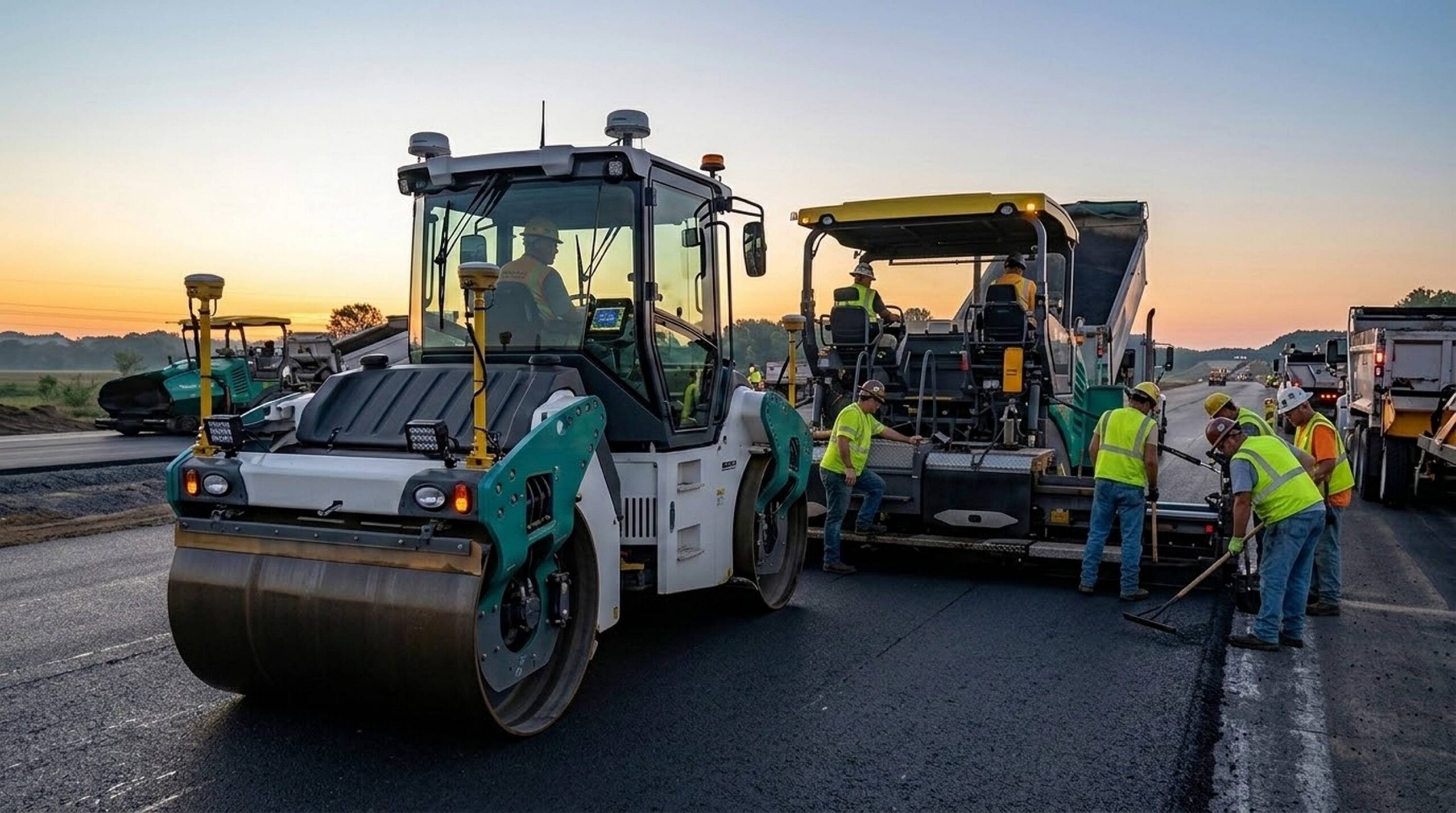
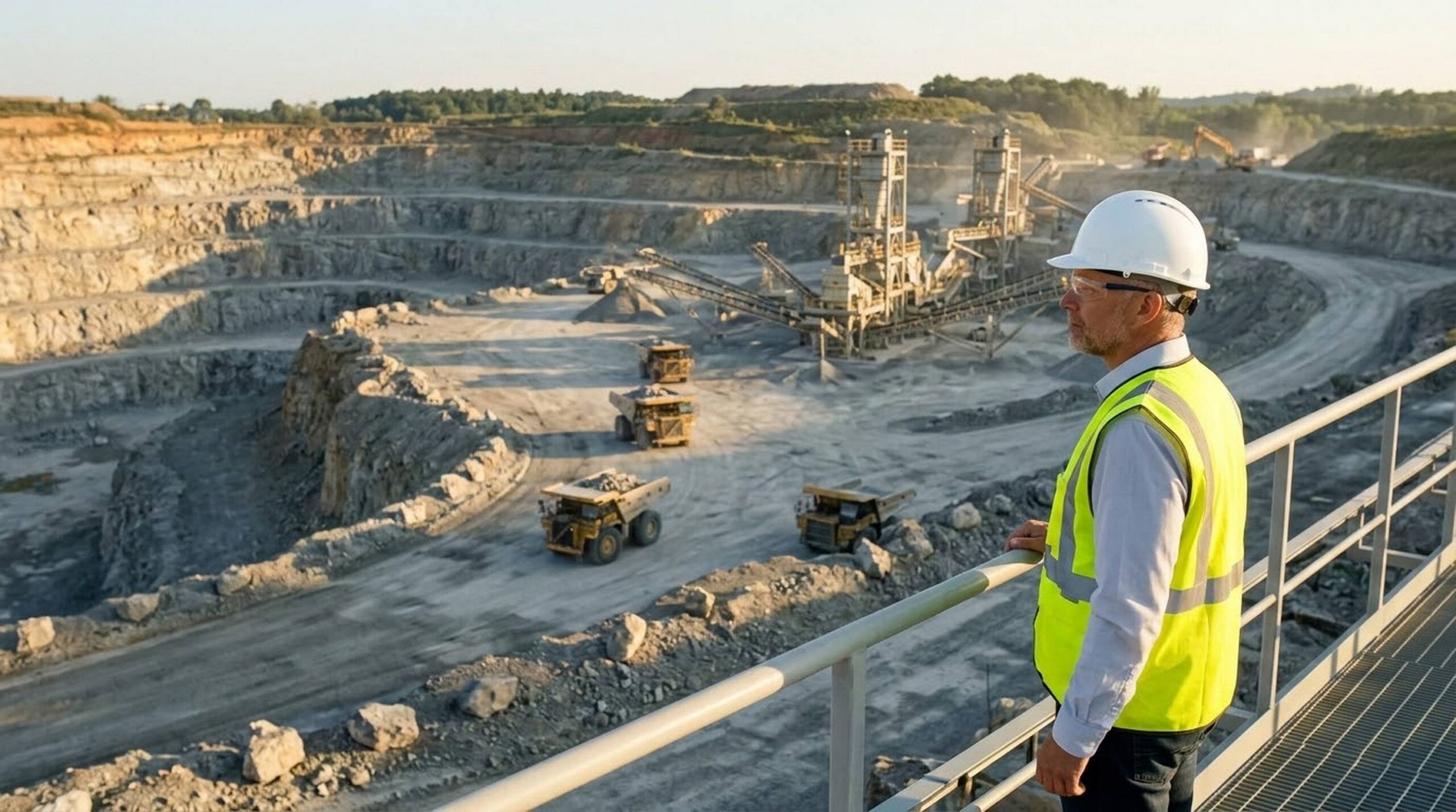
Look across a modern American civil infrastructure or heavy industrial site today, and you will see the full deployment of Industry 5.0 in action. Modern sites have evolved past isolated machinery into highly synchronized operations where current manufacturing technology trends leverage sensor-driven networks to overcome deep-seated talent shortages and protect active backlogs.
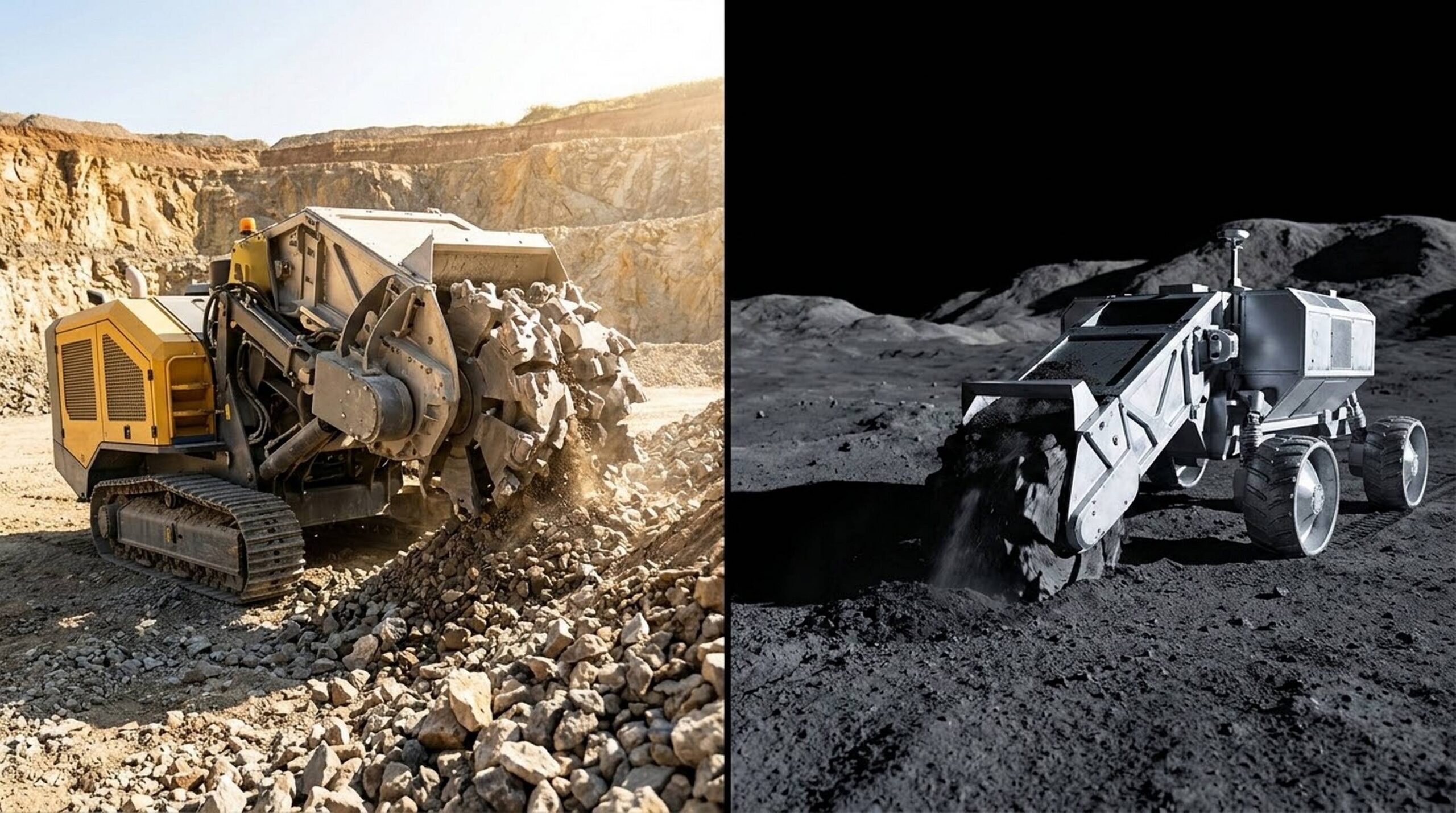
The heavy equipment fleet is no longer just a collection of mechanical iron. Excavators, scrapers, and bulldozers utilize automated GPS grading systems that link directly to the project’s 3D BIM (Building Information Modeling) design file. The machine knows exactly where the subgrade is down to the millimeter, preventing over-excavation and saving thousands of tons of aggregate fill material.
| Industry 5.0 Component | Hardware & Physical Execution | AI & Cognitive Integration Layer |
| Robotics & Heavy Fleet | Autonomous excavators, automated welding rigs, GPS grading iron | Real-time telemetry, automated grade adjustment files |
| Human Craft Integration | Precision assembly crews, master field riggers | Wearable AR guidance, remote senior engineer overhauls |
| Operations & Logistics | Predictive parts warehousing, supply chain routing | Active AI Agents auto-generating maintenance orders |
Furthermore, Agentic AI systems are now running in the background of active job sites. As detailed in recent strategic breakdowns on 5G infrastructure and digital twins, these high-bandwidth, ultra-low-latency networks allow AI agents to actively monitor real-time telematics from a fleet of heavy equipment.
These systems cross-reference oil analysis data with factory wear models, and automatically check local warehouse inventories to order a replacement hydraulic pump before the machine fails on the job. They dynamically rewrite the project’s master schedule to keep the civil crew moving seamlessly around the delayed asset.
Conclusion: The Next 250 Years of American Grit
As we look out across the United States this 250th Independence Day, the legacy of our industrial founding fathers remains vibrant and alive. The spirit of Ben Franklin’s practical physics, Thomas Edison’s relentless commercialization, Nikola Tesla’s elegant system design, and George Westinghouse’s scaling muscle is hardcoded into our national DNA.
The challenges of the next 250 years are immense. We have to rebuild aging bridges and tunnels, harden our national electrical grid against unprecedented climate demands, secure domestic supply chains for mission-critical materials, and train a new generation of highly technical craft professionals to manage the automated job sites of tomorrow.
But if the history of American industry proves anything, it is that we are at our best when the tasks are large, the margins are tight, and the stakes are existential. We are a nation built by the foundry, the mine, the grid, and the rocket. And the future belongs to the builders.
Build Your Future with Resource Erectors
At Resource Erectors, we have spent decades partnering with the premier organizations and top-tier talent driving America’s heavy industrial sectors. Whether you specialize in mining, aggregates, civil construction, heavy manufacturing, or engineering, we connect world-class professionals with industry-leading employers to build the future of Industry 5.0.
- Looking for your next career breakthrough? Explore our comprehensive, up-to-date Job Board to find your next professional destination.
- Ready to take the next step? You can quickly Submit Your Resume for General Consideration to stand out to our specialized recruiting team.
- Ready to solve your workforce challenges? Discover how our customized recruitment strategies help you secure elite professionals by learning more About Resource Erectors today.
References
Christensen, C. M. (2011). The Innovator’s Dilemma. Vahlen. http://lib.ysu.am/open_books/413214.pdf
Gordin, R. (n.d.). Nucor Corporation: A study on operational efficiency. University of Pennsylvania. https://repository.upenn.edu/server/api/core/bitstreams/2741add7-1cb3-41bd-92f7-ac15f75537af/content
Jones, M. K. (2022). Innovators and the development of mini-mills for steel recycling: Lessons for the development of a circular economy from the steel industry. Colorado School of Mines. https://www.mines.edu/global-energy-future/wp-content/uploads/sites/361/2022/10/Payne-Institute-Commentary-Lessons.pdf