By the Resource Erectors Research Team
The energy landscape is undergoing a structural transition. As heavy industry, data centers, and manufacturing hubs demand higher power density, the reliability gap left by intermittent renewables is widening. The reliability gap is widening because surging energy demand, driven by electrification and data centers, is outpacing renewable supply growth, creating supply shortfalls when the sun isn’t shining and wind isn’t blowing. To bridge this critical shortfall, grid operators are accelerating the adoption of dispatchable, zero-emission technologies and storage.
We are seeing a shift away from the monolithic, decade-long construction projects of the past toward “Answer-First” energy: Small Modular Reactors (SMRs).
This isn’t just a trend; it is the industrialization of nuclear power. By applying factory-scale manufacturing and modular engineering, developers are turning nuclear energy into a commodity that is faster to deploy, easier to secure, and increasingly cost-effective.
The Gravity Reactor: Going Deep for Safety
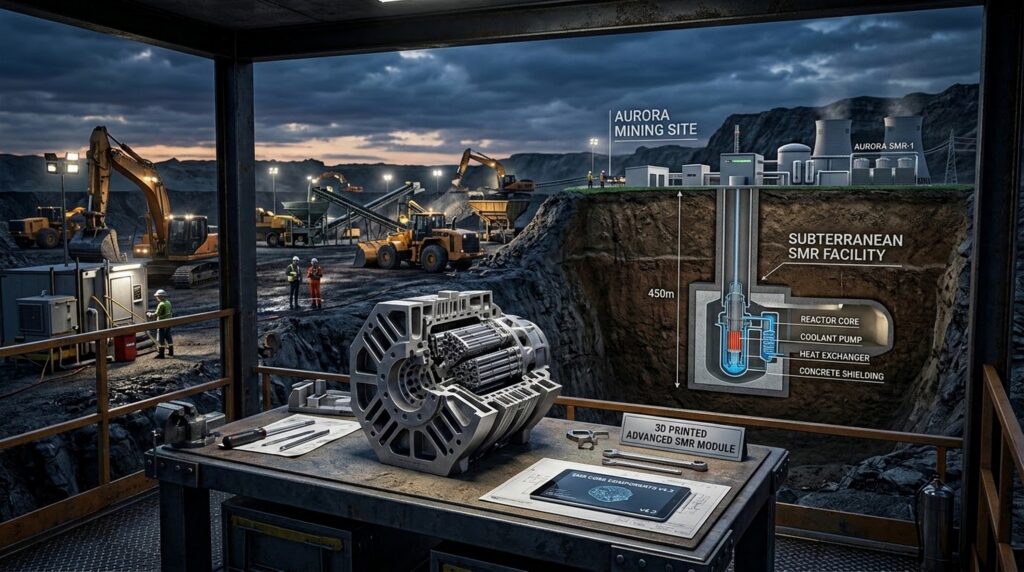
One of the most compelling innovations in this space comes from California-based Deep Fission. Their “Gravity” reactor design fundamentally reimagines the site footprint by moving the reactor one mile (1.6 km) underground into an optimized borehole.
This is nuclear energy stripped to its essentials:
- Geological Containment: By utilizing the natural shielding and containment of the surrounding earth, the design enhances inherent safety and security.
- Scalability: Each reactor generates 15 MWe. The design is modular, meaning ten reactors on a single site deliver 150 MWe, while 100 reactors produce 1.5 GWe.
- Technical Synergy: The design integrates mature technologies from the nuclear, oil and gas, and geothermal industries, utilizing off-the-shelf parts to accelerate deployment.
Deep Fission broke ground in December at the Great Plains Industrial Park in Parsons, Kansas, for its pilot project and plans to build a full-scale commercial plant there following the demonstration of the test reactor. In August last year, Deep Fission was one of 10 companies selected by the US Department of Energy to receive support under its Nuclear Reactor Pilot Program.
The project is now bolstered by a strategic partnership with Day & Zimmermann (D&Z), a firm with over 40 years of expertise in the power industry. D&Z brings the quality programs required by the Nuclear Regulatory Commission (NRC) and the experience needed to build the non-nuclear, above-ground turbine generator systems for the Gravity reactor.
This alignment of “first-of-a-kind” technology with “proven” industrial discipline is a critical milestone in bringing advanced nuclear construction to reality.
The energy sector is seeing a broad acceleration in such initiatives. US SMR developers are rapidly announcing new partnerships to scale deployment and integrate these reactors into the grid.
Modernizing Manufacturing: The 3D-Printed Nuclear Future
While Deep Fission is redefining site architecture, NX Atomics, an Indiana-based developer, is revolutionizing the internal components of SMR platforms. They have partnered with Sciaky—a division of Morphix Metals—to apply Electron Beam Additive Manufacturing (EBAM), an advanced 3D-printing process, to the production of critical nuclear components.
3D printing isn’t just about speed; it is about metallurgical precision. The EBAM process produces fully dense, high-quality metal parts from alloys such as titanium, tantalum, Inconel, and stainless steel—materials essential for the harsh, high-temperature environments of nuclear reactors.
This is what nuclear manufacturing looks like in the modern era. By integrating aerospace-grade 3D printing into our clean energy infrastructure, developers like NX Atomics are:
- Lowering Unit Costs: Reducing the complexity and material waste of traditional machining.
- Accelerating Supply Chains: Producing nuclear-qualified parts on demand.
- Enhancing Lifecycle Flexibility: Creating a framework where components can be strategically swapped out over the lifetime of the reactor.
Sciaky’s EBAM technology has been relied upon by the world’s most demanding industries for over eight decades, with parts currently flying on commercial aircraft, sailing on naval vessels, and orbiting the Earth. Bringing that level of manufacturing capability into the nation’s clean energy infrastructure is a natural and necessary transition.
Strategic Synthesis: Why This Matters for Industry
For the leaders and operators of heavy industry, this shift represents a move toward true energy independence. We are witnessing the maturation of modular nuclear technologies that can provide the base-load stability required for mining, mineral processing, and large-scale civil infrastructure.
These developments highlight a broader trend toward localized, high-density power that is inherently safe, secure, and easier to scale. As SMRs transition from pilot projects to grid-connected assets, the demand for project managers, nuclear code engineers, and operations leads who understand this new generation of energy infrastructure will outpace the current supply.
The industrial sector is moving toward a future that is smaller, deeper, and more manufactured than ever before. We are tracking these innovations as essential building blocks for the next industrial cycle, in which energy is no longer just a utility; it is a secure, on-site strategic asset.
Confidential Hiring Opportunities at Resource Erectors
If you are a high-level professional seeking confidential representation or wish to submit your resume for general consideration for current and future confidential hiring opportunities, please submit via our secure portal here:
Submit Your Resume to Resource Erectors for General Consideration.
Are you building the team that will power the next industrial revolution?
If your company is scaling up operations to meet the demands of the modern energy era, you need a recruitment partner who understands the intersection of heavy industry, mining, and advanced energy technology.
- View our active recruitment services: https://resource-erectors.com/client-recruiting-services/
- Explore current opportunities in the field: https://resource-erectors.com/jobs-mining-construction-materials/
Get in touch with our expert team:https://resource-erectors.com/contact/