By the Resource Erectors Research Team
In modern industrial mineral processing, mining, and metallurgy, the extraction of high-value commodities is no longer defined simply by raw tonnage. As run-of-mine ore grades vary and market specifications for industrial minerals tighten, the profitability of a processing operation hinges on a single operational metric: recovery efficiency at the lowest per-ton operating cost.
Transforming raw extracted feedstocks into premium, market-ready concentrates requires precise wet-beneficiation circuits. At the heart of this process stand two foundational unit operations: gravity separation and froth flotation.
While each method relies on fundamentally different physical and chemical mechanisms, modern processing plants increasingly combine both into hybrid, closed-loop flowsheets. Managing these continuous systems requires an elite technical understanding of slurry rheology, surface chemistry, and mass-balance optimization.
Gravity Separation: Maximizing Specific Gravity Differentials
Gravity separation remains one of the most cost-effective, environmentally sound beneficiation methods available in heavy industry. By exploiting natural differences in specific gravity (SG) between target mineral particles and gangue rock, gravity circuits achieve high throughput without heavy chemical reagent costs.
Core Separation Mechanisms
In a dynamic fluid medium (typically water), particles experience varying settling velocities determined by their density, size, and shape:
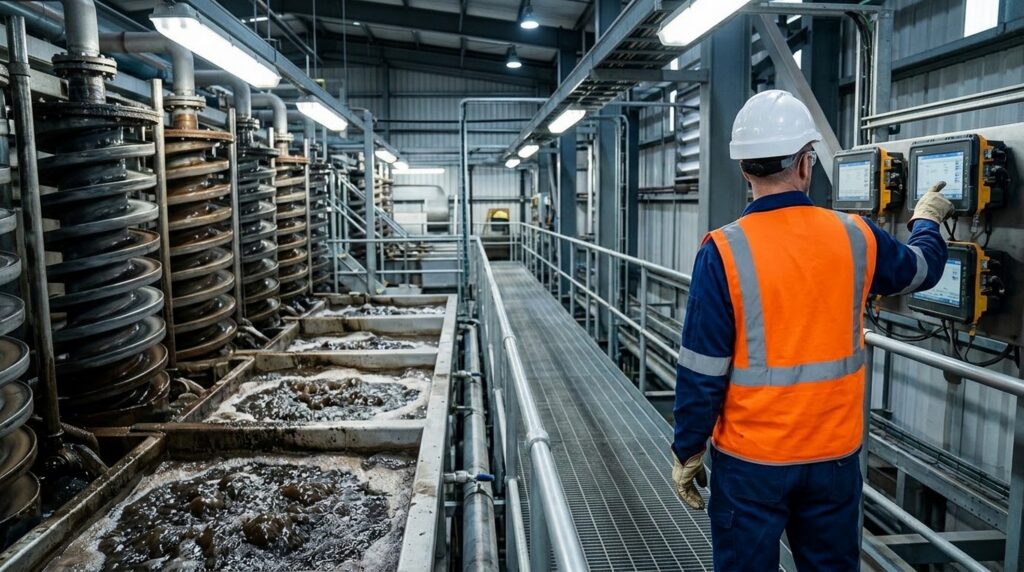
- Spiral Concentrators: Widely deployed in heavy mineral sands, iron ore, and coal washing, spirals utilize centrifugal force and differential fluid drag along a helical trough to stratify heavy minerals toward the inner column while lighter silica gangue washes outward.
- Shaking Tables & Falcon Concentrators: For fine and ultrafine recovery, reciprocating tables and high-G centrifugal concentrators capture high-density particles that standard settling pools lose to slimes.
- Hydrocyclones & Dense Media Separators (DMS): Utilizing engineered dense media (such as ferrosilicon or magnetite slurries), DMS circuits cleanly float off low-density gangue while sinking high-density concentrates under accelerated centrifugal forces.
Operational Advantages & Limitations
Gravity separation delivers low OPEX, minimal environmental permitting friction, and simple operational maintenance. However, as particle size drops below 75 microns (-200 mesh), hydrodynamic drag forces overpower gravitational forces, causing traditional gravity circuits to lose recovery efficiency.
That is precisely where chemical surface manipulation takes over.
Froth Flotation: Engineering Hydrophobic Surface Chemistry
Froth flotation represents one of the greatest technological achievements in chemical engineering, enabling the selective separation of minerals based on their surface wettability rather than density.
The Three-Phase Separation Process
Inside mechanical or pneumatic flotation cells, finely ground mineral slurry is conditioned with specialized chemical reagents:
- Chemical Conditioning: Collectors selectively adsorb onto the crystalline surfaces of target minerals (such as sulfides, silicates, or phosphates), rendering them hydrophobic (water-repellent).
- Aeration & Particle Attachment: Micro-fine air bubbles are dispersed throughout the agitated slurry. Hydrophobic particles naturally attach to rising air bubbles, while hydrophilic (water-attracting) gangue remains suspended in the pulp.
- Froth Recovery: Mineral-laden bubbles rise to the surface, forming a stable froth layer that cascades over cell launders into concentrate collection tanks for dewatering and filtration.
Flotation gives processing plants unmatched selectivity, allowing engineers to separate minerals with virtually identical specific gravities by manipulating pH and chemical depression circuits.
Designing the Hybrid Flowsheet: Gravity Roughing Meets Flotation Cleaning
Leading mineral processing facilities rarely rely on a single separation technique. High-efficiency operations deploy hybrid beneficiation flowsheets that integrate gravity circuits ahead of froth flotation banks to optimize capital and energy expenditure:
BENEFICIATION CIRCUIT INTEGRATION
| Circuit Stage | Primary Technology | Core Operational Objective |
| Stage 1: Scalping / Roughing | High-Capacity Gravity Spirals / DMS | • Reject coarse barren gangue early • Reduce downstream grinding mill load |
| Stage 2: Regrind & Classification | Hydrocyclones & Stirred Media Mills | • Liberate locked fine minerals • Achieve target particle size distribution |
| Stage 3: Flotation Roughing & Scavenging | Mechanical / Column Flotation Cells | • Maximize overall mineral recovery • Pull ultrafine target fractions |
| Stage 4: Flotation Cleaning & Polishing | Multi-Stage Cleaner Banks | • Upgrade concentrate to final purity specs • Depress penalty gangue elements |
By scalping out free gangue early with low-cost gravity circuits, plants drastically reduce the volume of material that requires expensive fine grinding and reagent conditioning. This integrated flowsheet reduces power consumption, lowers reagent spend, and stabilizes final concentrate grades.
Operational Leadership: Bridging Process Chemistry and Plant Floor Execution
Achieving peak metallurgical recovery requires more than advanced instrumentation; it demands decisive operational leadership. Modern processing hubs are deploying AI-driven ERP and maintenance systems to track slurry density, reagent dosing rates, and mass balance in real time.
However, automated sensors cannot replace seasoned technical intuition. Plant leaders must continuously evaluate operational trade-offs:
- Grinding Energy vs. Liberation: Finding the optimal grind size that liberates target minerals without over-grinding into unrecoverable ultrafine slimes.
- Reagent Dosage Control: Balancing collector and frother addition to maximize grade without overloading cleaner banks or complicating downstream tailings dewatering.
- Circuit Uptime & Slurry Wear: Managing extreme abrasive wear on slurry pump impellers, cyclone vortex finders, and flotation rotors to prevent costly unplanned shutdowns.
As plants modernize to meet surging demand for industrial minerals and critical raw materials, having field-proven industrial superintendents and operations directors at the helm is critical to commercial success.
Featured Career Opportunity: Process Superintendent (Job #846)
For engineering and operations leaders who possess a deep technical mastery of wet mineral processing, froth flotation, and gravity separation, Resource Erectors is currently featuring a premier, high-visibility role:
Job Spotlight #846 — Process Superintendent – Minerals Processing
This key leadership position is tailored for an accomplished metallurgical or process engineering professional ready to take full operational ownership of a multi-circuit mineral beneficiation facility.
Key Position Focus
- Direct Metallurgical Oversight: Driving process optimization, recovery rates, and throughput across grinding, classification, gravity separation, and flotation circuits.
- Operational Team Leadership: Mentoring shift supervisors, process engineers, and plant operators while instilling a strong culture of MSHA and environmental compliance.
- Continuous Improvement & Reliability: Leading root-cause failure analysis, coordinating with maintenance superintendents on plant shutdowns, and managing capital upgrade projects.
- Executive Reporting: Tracking plant KPIs, mass balances, and operating cost metrics to deliver consistent bottom-line results.
The Resource Erectors Takeaway for Heavy Industry Professionals
The industrial mineral and metallurgical processing sectors are experiencing sustained capital investment. As producers scale up domestic capacity to feed high-tech manufacturing, infrastructure projects, and next-generation industrial energy systems, the demand for expert process superintendents has reached an all-time high.
Elevating your career into senior plant leadership allows you to apply your technical knowledge directly where it drives bottom-line profitability.
Ready to Advance Your Career in Minerals Processing?
If you have proven expertise in optimizing complex mineral processing circuits and leading high-performance plant teams, take the next step today.
Apply directly to Job #846: Process Superintendent – Minerals Processing, or explore other executive and engineering opportunities on the Resource Erectors job board.
You can also submit your resume for general consideration to get your credentials confidentially reviewed by CEO Dan Duszynski for upcoming, unadvertised leadership roles.
Time to Call Resource Erectors
At Resource Erectors, we specialize in connecting heavy civil, mining, aggregates, and industrial mineral producers with elite technical leaders who drive operational excellence.
- For Employers: When your operation requires experienced process superintendents, metallurgists, or plant operations directors, explore our specialized client recruitment services.
- For Professionals: When you are ready to explore confidential, high-paying career moves in North America’s top processing hubs, visit our contact page today.