By the Research Erectors Research Team
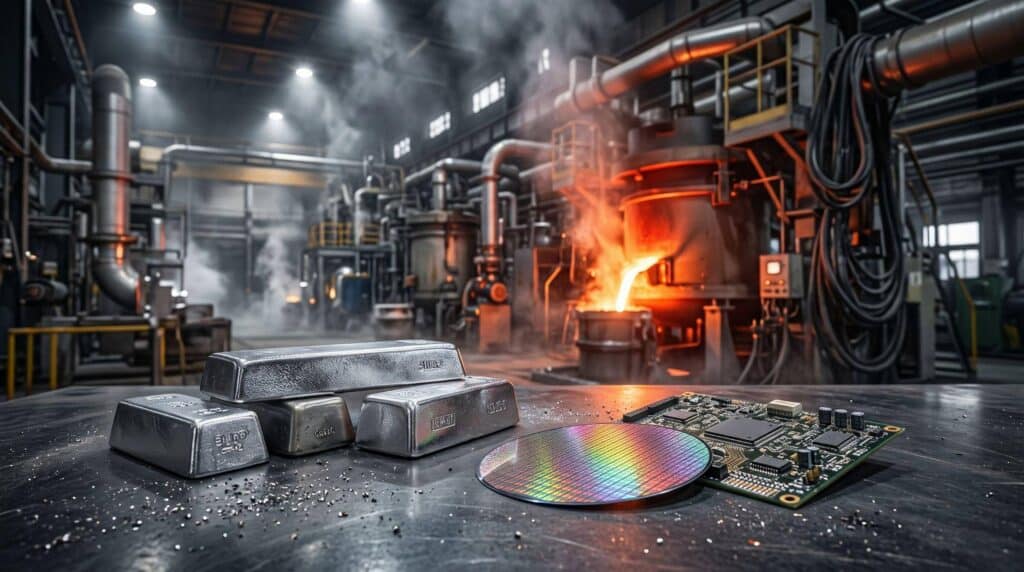
Today, the multi-billion-dollar semiconductor conversation in North America usually centers on cleanrooms, extreme ultraviolet (EUV) photolithography, and monumental mega-fab construction sites. Yet every advanced DRAM module and high-bandwidth memory (HBM) chip powering artificial intelligence data centers begins thousands of miles upstream in heavy industrial mills, chemical flotation circuits, and pyrometallurgical smelters.
Silicon wafers can’t transmit electrons without high-purity dopants, precision thermal interfaces, target metallization sputtering alloys, and specialized soldering compounds. Without uninterrupted extraction and ultra-pure refining of critical minerals like indium, gallium, germanium, antimony, and high-purity copper, modern semiconductor cleanrooms grind to an unproductive halt.
The technology sector is now learning what seasoned heavy industry operators have known for generations. Clean tech cannot exist without raw grit, advanced metallurgy, and domestic mineral processing capacity.
The Upstream Pivot: Micron Backs Indium Corporation in Rome, New York
In late October 2026, memory giant Micron Technology delivered an unmistakable message to global supply chains by executing a strategic investment in Indium Corporation‘s Rome, New York facility.
Indium Corporation, a legacy materials developer and refiner operating for over nine decades in the Mohawk Valley, entered into a long-term supply agreement with Micron to expand domestic critical minerals processing and manufacture semiconductor-grade, ultra-high-purity materials.
As detailed in official announcements covered by GlobeNewswire’s Micron Supply Chain Report, the direct funding agreement falls under Micron’s broader strategic initiative to deploy up to $3 billion across the US domestic semiconductor supply chain ecosystem, part of an overall $250 billion-plus manufacturing buildout planned through 2035.
While Micron proceeds with foundational site development on its historic mega-fab in Clay, New York, corporate leadership recognized an existential vulnerability. Building multi-billion-dollar fabrication cleanrooms without domestic upstream mineral refining creates an unstable supply chain structure. By partnering with Indium Corporation to restart and expand domestic mineral processing capacity, Micron is securing vital material inputs directly at the chemical source.
Beyond the Fab: The Harsh Realities of Critical Mineral Refining
The geopolitical stakes surrounding semiconductor materials, among other essential minerals, have intensified dramatically over the past two years. Geographically concentrated export restrictions and trade weaponization covering gallium, germanium, and antimony have exposed the structural fragility of global technology supply chains.
Extracting ore is only the first hurdle. The real industrial bottleneck lies in beneficiation and chemical refining, where metallurgical engineers must separate trace elements from bulk concentrates and refine them from standard commercial grades to 99.9999% (6N) or 99.99999% (7N) semiconductor purity.
Achieving that extraordinary level of purity is not software engineering. It is grueling, high-precision chemical engineering, hydrometallurgy, vacuum induction melting, and fractional crystallization. For decades, Western industry offshored these energy-intensive, chemically complex stages, leaving domestic manufacturers reliant on foreign monopolies for elements that measure in grams per ton of processed ore.
The Micron-Indium partnership shows that reshoring manufacturing requires bringing back the chemical processing plant, the smelting circuit, and the raw-material supply chain.
From Base Metals to High Purity: The Chemical Refining Circuit
Transforming raw mineral concentrates into semiconductor-grade precursors involves punishing mechanical and chemical processes. Minerals like indium rarely occur in standalone, high-grade deposits; they appear as trace elements in base-metal ores, primarily zinc sphalerite and copper sulfides.
As highlighted in technical manufacturing analyses by Manufacturing Dive’s Critical Minerals Assessment, extracting these vital elements requires sophisticated pyrometallurgical smelting followed by complex hydrometallurgical recovery:
- Leaching and Solvent Extraction: Concentrated acid leaches strip target metals from furnace dust, slag, and residues, followed by multi-stage liquid-liquid solvent extraction circuits to isolate trace elements from iron, cadmium, and arsenic.
- Electrowinning and Precipitation: Chemical precipitation and electrolytic deposition recover the target metal as a metal, producing commercial-grade sponge or cathode plates.
- Fractional Distillation and Zone Refining: To eliminate microscopic impurities that degrade electron transport, specialized furnaces heat the metal to controlled vapor points or pass molten zones through ingots, driving volatile impurities out until chemical purity reaches six-nines or seven-nines.
Managing these intense thermal and chemical balances requires elite operational leadership. A minor deviation in bath pH, thermal equilibrium, or atmospheric purging ruins an entire production run, costing hundreds of thousands of dollars in high-value feedstock.
The New Industrial Hero: High-Purity Metallurgy and Chemical Plant Leadership
This aggressive re-engineering of the materials supply chain is driving unprecedented demand for specialized technical leadership across the industrial minerals and materials-processing landscape.
Building cleanroom-ready ingots, target metallization disks, and high-purity alloy powders requires operational talent that understands heavy continuous-process manufacturing combined with pharmaceutical-grade contamination control:
- Metallurgical and Process Engineers: Experts who can optimize hydrometallurgical leaching, solvent extraction, electrowinning, and zone refining circuits to maximize recovery rates and hit extreme purity thresholds.
- Quality and Environmental Health and Safety Directors: Leaders capable of navigating stringent EPA environmental compliance, closed-loop water treatment, and dangerous chemical handling while maintaining maximum uptime.
- Plant Operations Managers and Superintendents: Veteran industrial commanders who possess the physical grit to manage high-temperature pyrometallurgical furnaces and the operational discipline to enforce Six Sigma continuous improvement across every shift.
Engineers and operational leaders possessing these specialized competencies find themselves in the driver’s seat of North America’s industrial revitalization. The modern industrial minerals manager is no longer confined to traditional gravel pits or copper seams; they are the strategic linchpin securing the future of artificial intelligence, defense hardware, and telecommunications.
Engineering the Foundation: Heavy Industry Sets the Pace
The lessons of 2026 are clear. You cannot code your way out of a physical materials deficit. High-tech manufacturing is inextricably bound to the physical earth and the industrial processing mills that convert raw geology into technological assets.
As capital expenditures pour into Upstate New York, the Midwest, and the Sun Belt, the companies that thrive will not be those with the flashiest software roadmaps, but those that lock down dependable upstream refining and secure elite operational leaders to manage the facilities.
Heavy industry has always built America’s bedrock. Today, it is forging the microchip frontier.
Time to Call Resource Erectors
Developing, identifying, and securing elite engineering leadership is the single greatest competitive advantage in modern heavy industry.
As processing operations grow increasingly sophisticated and domestic critical mineral processing expands across North America, companies cannot afford prolonged vacancies in their operational, process engineering, or executive ranks. Leaving mission-critical seats open stalls capital projects as the High Cost of Vacancy burns through operating margins.
Resource Erectors specializes in heavy industry human resources.
With decades of experience, we connect North America’s premier producers across mining, aggregates, industrial minerals, concrete, and heavy civil construction with the top 10% of engineering, sales, safety, and management talent. That’s why over 85% of Resource Erectors professionals are still contributing to the success of our client companies more than 5 years later, and counting.
It’s also why today’s 6-figure level engineering leaders have relied on CEO Dan’s career management expertise, starting at the first job fresh from college, to retirement at the top. And now in 2026, we have the “Unretirement” step to top the career ladder. If you’ve been suffering from FOMO (Fear of Missing Out) on those 6-figure salaries and amazing benefits, contact CEO Dan today to explore the value of your experience in today’s unprecedented infrastructure boom.
- Partner with our specialized recruiters to build an exceptional operational roster through our comprehensive client recruitment services.
- Discover high-compensation engineering, plant management, and technical sales opportunities across North America on the Resource Erectors job board.
- Advance your career confidentially and position yourself on CEO Dan Duszynski’s executive short list for premier positions that never hit public boards when you submit your resume for general consideration.
- Ready to solve your company’s most demanding operational talent challenges? Reach out directly through our contact page today.