By the Resource Erectors Research Team
For decades, the asphalt paving sector earned a reputation as one of the most stubborn, tradition-bound corners of heavy civil infrastructure. Paving crews judged mat consistency by eye, gauged temperature by the soles of their work boots, and verified density hours after the rollers left the job site with nuclear gauges or core-drill samples.
That legacy era has officially hit the end of the road.
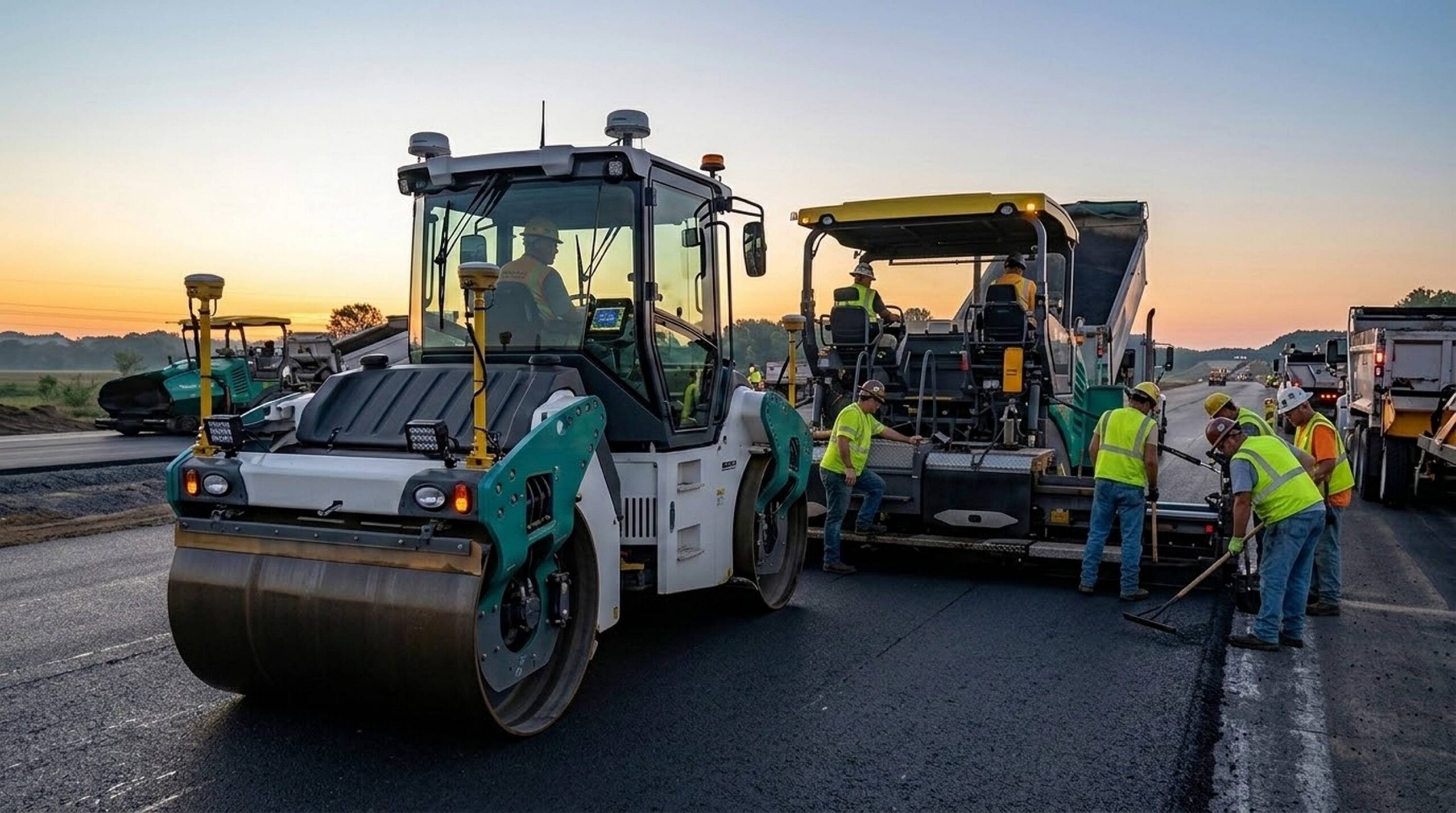
Stricter state DOT ride-quality bonuses, aggressive penalty clauses, and soaring binder costs are turning highway paving into an exact digital science. Real-time thermal profiling, artificial neural network density mapping, and autonomous paver guidance systems now govern the job site.
This high-tech pivot is not just changing how hot-mix asphalt (HMA) and warm-mix asphalt (WMA) are placed in the field. It is radically redefining the operational competencies demanded of asphalt plant managers, paving superintendents, and heavy highway project executives.
The Cold Spot Conundrum: Eliminating Thermal Segregation
In asphalt paving, temperature uniformity is the single most important variable determining whether an interstate roadway lasts twenty years or cracks in three.
When hot mix is hauled from the batch plant in dump beds, the crust cools faster than the core. If that temperature variation is dumped directly into the paver hopper without proper remixing, the resulting “thermal streaks” create localized low-density pockets. These cold spots fail to compact properly, leading to premature raveling, pothole formation, and longitudinal joint failure.
To solve this, advanced contractors are deploying continuous thermal profiling systems:
- Infrared Sensor Bars: Mounted directly behind the screed, full-width infrared camera arrays take up to 40 temperature readings per second across the entire width of the mat.
- Real-Time Thermal Mapping: Operators and inspectors watch live color-coded temperature maps on cab displays. If a cold truckload arrives or a material transfer vehicle (MTV) is bypassing remixing, the system flags the thermal differential instantly.
- E-Ticketing and Telematics Integration: The thermal data links directly to digital delivery tickets, associating exact mix temperature profiles with specific batches and quarry aggregate sources.
State transportation departments have taken notice. An increasing number of agencies now tie contractor pay factors directly to thermal uniformity profiles, rewarding contractors who eliminate thermal streaks with six-figure performance incentives.
Intelligent Compaction: The Rise of AI Density Mapping
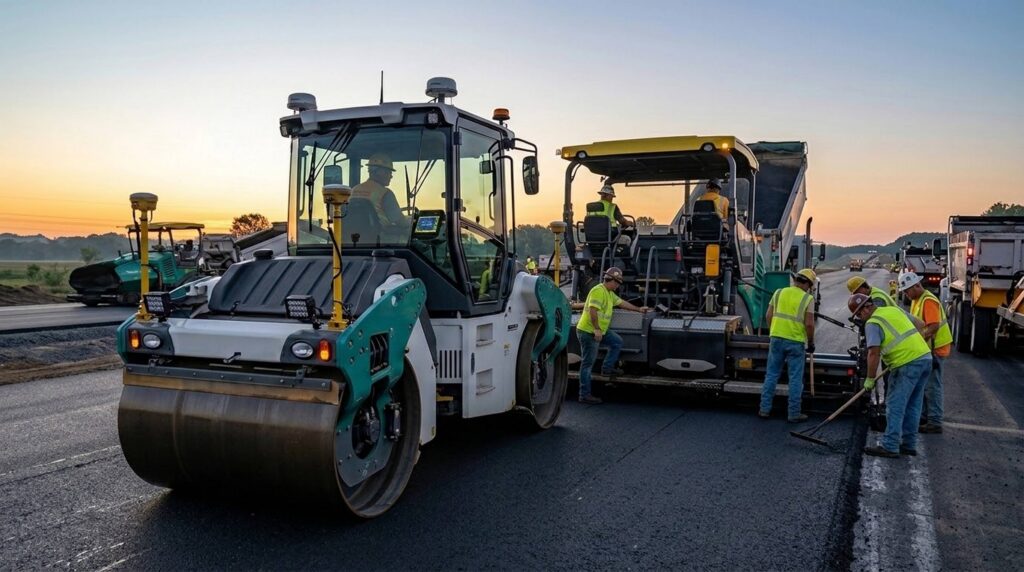
The true high-tech frontier in roadbuilding is unfolding on the roller deck through Intelligent Compaction (IC).
Historically, roller operators followed a static “rolling pattern” determined by a small test strip laid earlier in the week. But ambient wind, declining mix temperatures, and variable sub-base stiffness mean that a fixed pass count often leaves some sections under-compacted while crushing aggregate particles through over-compaction in others.
Modern IC rollers change this dynamic through closed-loop automation:
- Accelerometers on the Drum: Precision accelerometers measure the drum’s rebound response off the asphalt mat with every vibration cycle, calculating a continuous stiffness metric.
- Satellite RTK-GPS Guidance: Differential GPS units track the roller’s position down to the centimeter, mapping pass counts across the entire lane.
- Artificial Neural Networks (ANN): Cutting-edge systems run live temperature, speed, vibration frequency, and accelerometer data through self-learning neural network algorithms. Instead of guessing, the operator views a real-time color contour map displaying 100% of the mat’s target density.
When the screen turns green, the operator knows the pavement has achieved target density without fracturing stone or wasting fuel on unnecessary passes.
Autonomous Screeds and 3D Machine Control
Precision does not stop with compaction. Asphalt pavers are adopting the same robotic automation that transformed earthmoving and mining haulage.
By replacing traditional manual grade skis and stringlines with 3D GNSS positioning and robotic total stations, next-generation pavers automatically adjust screed elevation, cross-slope, and width in real time against digital engineering models.
These automated screed controls eliminate human operator lag, smooth out micro-bumps before the roller ever touches the mat, and drastically reduce asphalt over-yield, ensuring that contractors place the exact tonnage engineered in the civil design.
The Operational Hurdle: Upgrading Field Leadership
Equipping a paving train with high-tech sensors, infrared cameras, and artificial intelligence algorithms delivers immense value, but technology is only as effective as the leadership directing it.
The transition to high-tech paving has created an urgent demand for a new breed of field leadership:
- Data-Fluent Paving Superintendents: Highway contractors need superintendents who can interpret thermal plots, diagnose intelligent compaction data on mobile tablets, and coach roller operators to adjust patterns on the fly.
- Plant Automation Specialists: Asphalt batch plants require plant operators and QC managers who can integrate automated liquid binder injection, high-RAP (Recycled Asphalt Pavement) rejuvenator dosing, and digital dispatch software.
- Quality Control Directors: Technical managers who can interface directly with state DOT materials engineers, using continuous compaction logs to defend density results and maximize agency rideability bonuses.
Contractors that invest solely in high-tech iron while ignoring the development of their technical leadership find themselves drowning in data they cannot execute. The organizations dominating the heavy highway market are those pairing smart machines with elite operational talent.
The Resource Erectors Takeaway
The asphalt paving sector is proving that heavy infrastructure can be as digitally sophisticated as any advanced manufacturing plant.
From infrared thermal profiling to AI-powered intelligent compaction, high-tech tools are providing contractors with unprecedented control over pavement durability, job site profitability, and material efficiency.
Yet as machine technology leaps forward, human expertise remains the indispensable foundation. Securing the visionary project managers, plant superintendents, and materials engineers who understand how to translate digital telemetry into finished lane miles is the ultimate competitive advantage.
Ready to Elevate Your Heavy Civil Operations?
Whether your company is modernizing highway paving fleets, expanding asphalt plant networks, or scaling heavy civil infrastructure projects, Resource Erectors is your specialized recruitment partner across heavy industry.
- For Paving & Heavy Civil Employers: Secure battle-tested Paving Superintendents, Asphalt Plant Managers, and Quality Control Directors who master advanced paving technology. Explore our specialized client recruitment services.
- For Heavy Highway Professionals: Position your career at the forefront of modern infrastructure technology. Browse active nationwide career opportunities on the Resource Erectors job board.
- Confidential Placement: Many of our highest-compensation project executive and plant leadership searches are conducted discreetly under strict non-disclosure agreements. To ensure your credentials are on file for unlisted career opportunities, submit your resume for general consideration.
- Connect Confidentially: Contact CEO Dan Duszynski directly to discuss your executive talent needs or career plans by visiting our contact page today.
To see how real-time automated steering and automated screed guidance function on active highway projects, check out this look at the Autonomous Self-Driving Paver. This video illustrates the machine-control technologies and automated screed adjustments discussed above that are eliminating manual grade errors and establishing new benchmarks for roadway durability.