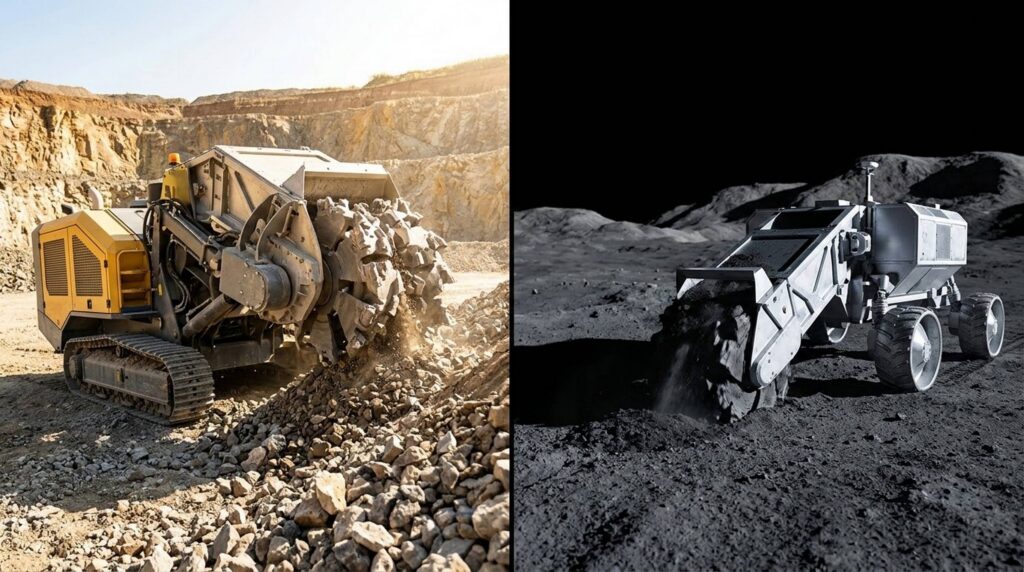
By the Resource Erectors Research Team
The US heavy civil construction, aggregates, and mining sectors stand on the cusp of a technological convergence that sounds like science fiction until you look at TOM’s 2026 balance sheets.
For decades, the extraction industry has viewed terrestrial bulk earthmoving and off-world resource extraction as entirely separate domains. Terrestrial operations focused on brute mechanical force, scale economics, and capital-intensive infrastructure. Meanwhile, off-world engineering lived inside walled aerospace laboratories funded by research grants.
Those walls are tumbling down, and not in 10 or 20 years, but right now in 2026.
As humanity establishes a permanent footprint beyond low Earth orbit, off-world infrastructure has transformed into a pressing materials challenge. Moving material out of the ground is the foundational prerequisite for every supply chain, from producing concrete aggregate in Texas to extracting water ice from a lunar crater.
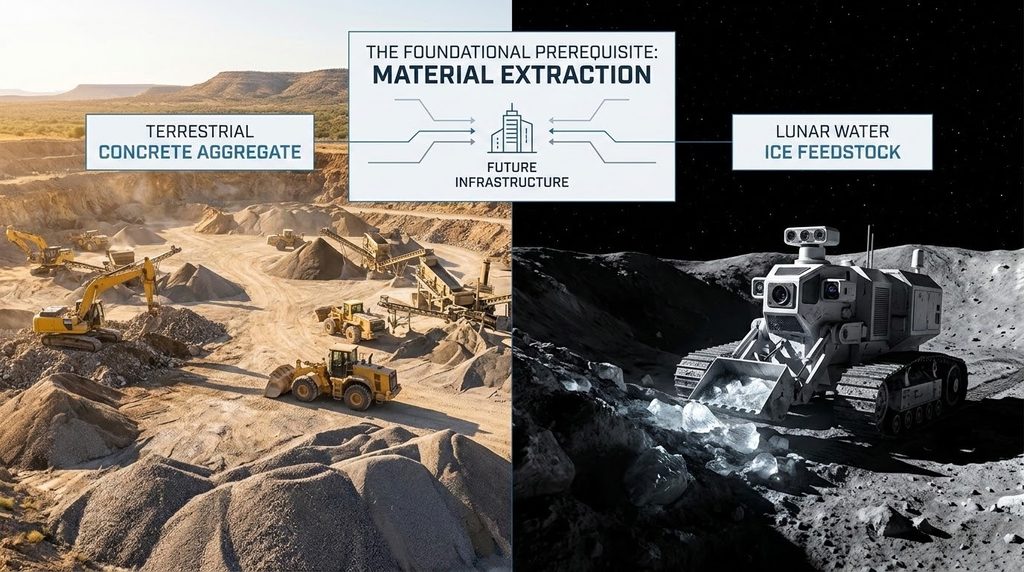
When we are evaluating long-term resource strategies, such as mining the future and deep subsurface tunneling, not to mention mastering high-capacity processing, the technical imperatives are strikingly similar across frontiers:
- ground control
- continuous material conveyance
- operator safety.
Space exploration has historically relied on a tightly closed loop. Every kilogram of structural steel, radiation shielding, water, and propellant had to be mined, refined, and launched from Earth at exorbitant cost.
Early NASA procurement milestones, such as the Break the Ice Lunar Challenge, show that true sustainability demands In-Situ Resource Utilization (ISRU). But off-world ground conditions introduce severe mechanical hurdles.
When industry pioneers first analyzed extraterrestrial extraction in our technical exploration, Engineering on the Moon: Can You Dig It? Part 2, the primary bottleneck was clear: regolith dust.
Now, an emerging dual-use enterprise is bridging this divide with an elegant engineering thesis: solve the dust problem at the mechanical intake, eliminate capital-heavy site prep, and let immediate cash flows from terrestrial aggregates finance the lunar supply chain. That company is:
Torres Orbital Mining (TOM)
The Common Denominator: The Dust Paradox on the Earth and the Moon
Excavating an aggregate deposit in the American Southwest and breaking frozen regolith at the lunar South Pole share a common hazard: uncontrolled particulate ejection can be an operational disaster.
The Terrestrial Crisis: Respirable Silica and Site Overhead
In conventional terrestrial surface mining, traditional heavy equipment (excavators, bulldozers, front-end loaders, and haul trucks) relies on brute kinetic disruption. Buckets tear into the ground, lift material high into the air, and drop it into haul beds or hoppers. This mechanical motion generates massive dust clouds.
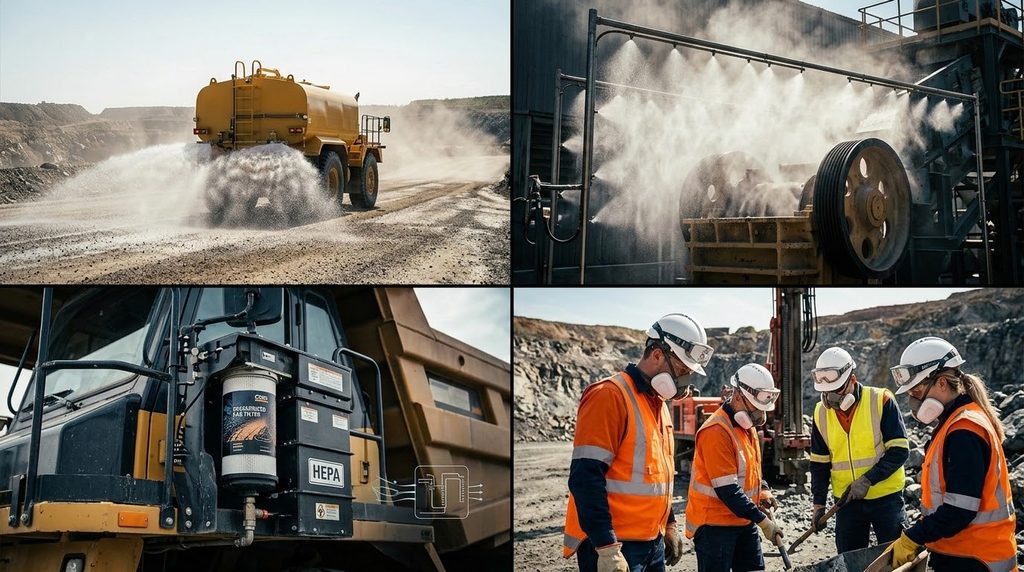
OSHA data shows that about 2.3 million workers in the United States are exposed to respirable crystalline silica on the job. The aggregates and mining industries spend tens of millions annually on dust suppression: high-volume water trucks, elaborate misting systems, pressurized cab filters, and personal protective equipment.
Beyond health and regulatory liabilities, conventional mining requires massive upfront capital before extracting a single salable ton. Operators must clear vegetation, level extensive acreage, construct wide, compacted haul roads, and install static processing plants.
Because this infrastructure requires millions of dollars in upfront capital, millions of small, high-quality aggregate deposits sit completely stranded across North America. The CFO’s math simply does not pencil out for an operator to build haul infrastructure for deposits under a few million tons.
The Lunar Bottleneck: Mechanical Destruction
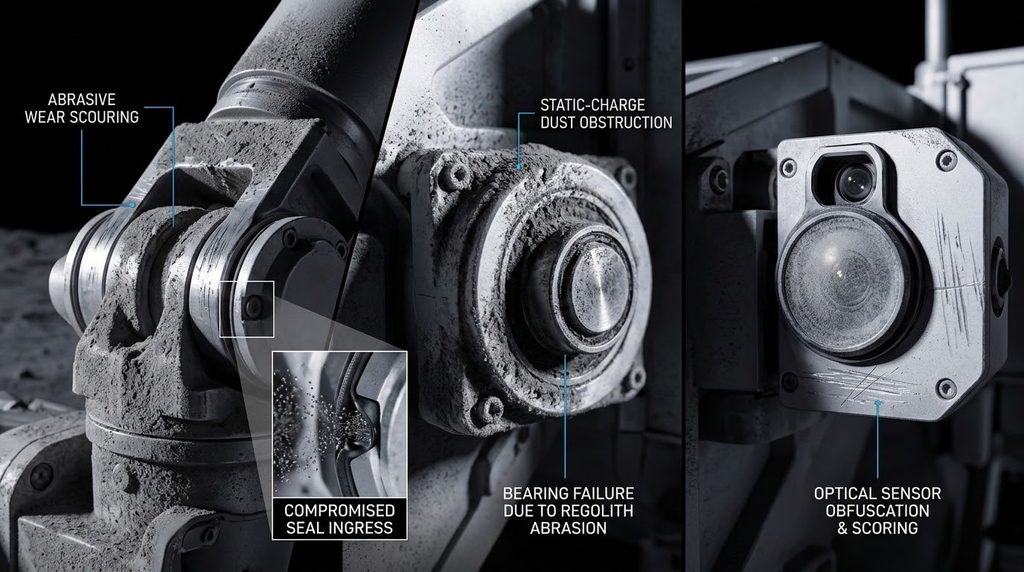
Lunar regolith particles are unweathered, razor-sharp, and electrostatically charged. In Apollo missions and simulated vacuum trials, regolith chewed through suit joints, abraded optics, destroyed mechanical seals, fouled bearings, and coated thermal radiators, rendering heat-rejection systems useless. Conventional Earth excavation methods, with open shovels flinging dirt into the air, will destroy lunar bases, habitats, and launchpads faster than they can build them.
To solve both problems, TOM asked a straightforward question: What if dirt never touches the air in the first place?
Core Technology: Dust-Free, Zero-Entry Excavation With TOM
Rather than digging material out, flinging it into the atmosphere, and fighting the resulting dust plume with water and filters, TOM’s technology contains and conveys material entirely inside a sealed machine.
1. The Non-Ejective Intake Bit (NIB)
At the core of the company’s intellectual property is the patent-pending Non-Ejective Intake Bit (U.S. Patent Pending #63/958,454). The NIB utilizes a counter-rotating drill head engineered to cut directly into the working face. As material shears away from the parent rock or compact regolith bed, internal flow dynamics route the particles directly into a sealed, dual-stage intake.
By eliminating the free-flight kinetic phase of bulk earthmoving, the material never enters the surrounding atmosphere or lunar vacuum. Fine particulate ejection drops to near zero, eliminating the need for water-intensive dust suppression while delivering a clean, pre-sized feedstock stream directly to secondary conveyance.
2. The ADHP Deterministic Autonomy Layer
Mining environments are inherently hazardous, but full end-to-end autonomy in unmapped, rough-terrain environments often fails when driven solely by probabilistic AI models. TOM addresses this via its proprietary Autonomous Deterministic Heavy Platform (ADHP) supervisory software layer.
ADHP pairs a deterministic rule-based supervisor with onboard operational AI. The deterministic architecture acts as an unyielding safety envelope, deciding precisely when and under what environmental parameters the machine’s onboard AI has authority to proceed.
If terrain anomalies, mechanical resistance, or sensing occlusions fall outside verified safety thresholds, authority defaults back to secure, pre-programmed protocols. This enables reliable “zero-entry” excavation, taking human equipment operators completely out of the silica danger zone on Earth and out of high-radiation environments in space.
Dual Platform Deployment: “Earth Machines Fund Moon Machines”
For investors evaluating deep-tech and space infrastructure ventures, the startup graveyard is filled with companies that burned through capital years before off-world markets reached commercial maturity. TOM avoids this capital trap by using the same foundational IP to target immediate, cash-generating terrestrial industrial markets.
| Platform Vector | A-Series “Abaster” (Terrestrial) | T-Series “Tochtli” (Lunar ISRU) |
|---|---|---|
| Operating Environment | Unprepared quarries, stranded deposits, civil sites | Permanent Shadowed Regions (PSRs), lunar vacuum |
| Core Primary Goal | Zero-silica aggregate extraction, zero site prep | Ballistic dust suppression, regolith feedstock recovery |
| Autonomy & Control | Supervised ADHP zero-entry continuous digging | Full deterministic autonomy in high-radiation zones |
| Commercial Model | Immediate cash-flow royalties with pre-secured offtakes | Infrastructure contracts for landing pads, berms, and ISRU |
Terrestrial Deployment: The A-Series “Abaster”
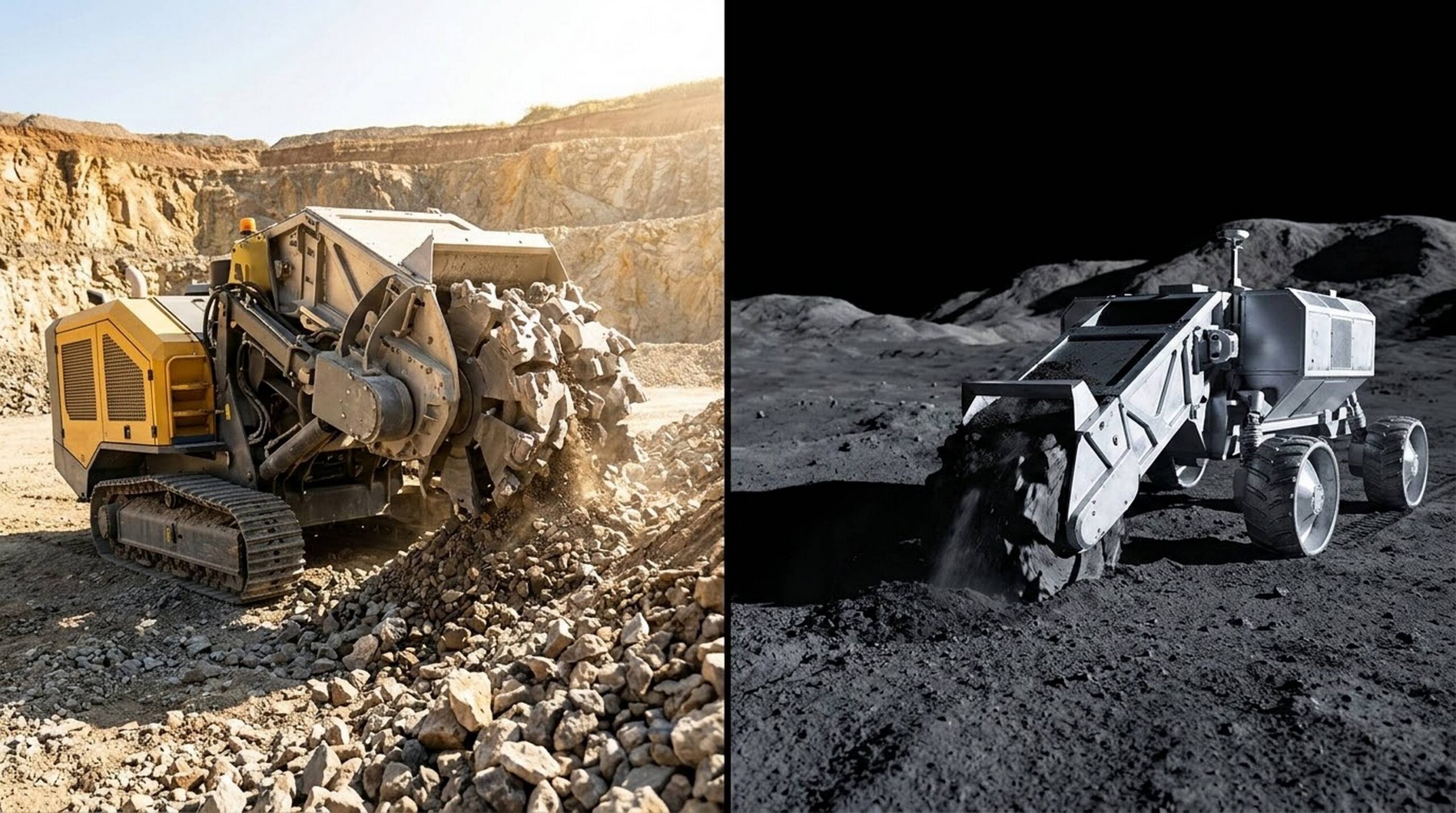
The fleet’s terrestrial workhorse is the Abaster, a rugged, 3-ton-class tracked crawler equipped with a scaled-up industrial NIB assembly.
The Abaster changes quarry and pit economics through its road-agnostic deployment. Conventional bulk mining requires a chain of road scrapers, excavators, haul trucks, and fixed crushers. The Abaster traverses unprepared, steep, and broken ground without preliminary clearing, tree removal, or road compaction. It excavates material into its sealed internal intake and feeds it directly into a mobile, drive-over hopper or a portable, rented screen plant.
Because initial capital overhead drops to near zero, TOM unlocks small-scale, high-margin deposits that conventional producers rule out. The commercial business model operates on a “Royalty, Not Land” structure:
- Landowners retain ownership of their property.
- TOM establishes an offtake agreement with pre-secured commercial buyers for a specific tonnage and price.
- TOM deploys the Abaster and modular screening plant, processes the required aggregate volume, pays the landowner a direct per-ton royalty, recovers its fleet, and leaves the land stable.
This structure eliminates land carry costs, avoids balance-sheet exposure to idle real estate, and delivers immediate gross margins.
Off-World Deployment: The T-Series Lunar Rovers
While the Abaster generates near-term terrestrial cash flow, TOM’s engineering pipeline reduces mass and increases autonomy for space.
- TZ-II Rover: An autonomous, lightweight testbed platform already built, lab-tested, and validated under simulated lunar conditions.
- Tochtli-Class Fleet: The production off-world platform, delivering approximately four times the excavation capacity per unit payload mass compared to early prototypes.
These systems provide clean, sealed regolith conveyance to feed downstream thermal extraction plants for water and rocket propellant, sintering kilns for landing pads, roads, and berms, and habitations for sub-surface radiation shielding.
Dual-Agency Momentum: NASA and ESRIC Backing Accelerates TOM Commercialization
Deep-tech ventures often face skepticism until external, tier-one technical authorities stress-test the underlying physics. Torres Orbital Mining has already crossed that essential threshold by securing simultaneous backing from the world’s leading aerospace institutions.
- NASA SBIR Phase I Contract ($225,000): NASA selected the Non-Ejective Intake Bit under a competitive Small Business Innovation Research Phase I award targeted specifically at lunar and Martian sampling. The contract funds hardware testing inside vacuum chambers using abrasive lunar regolith simulants, validating that the sealed, dual-stage mechanical intake suppresses particle ejection under true off-world conditions.
- ESRIC SSP6 Global Selection: The European Space Resources Innovation Center, Europe’s flagship institution dedicated entirely to off-world resource utilization, selected TOM as one of only seven companies worldwide for its competitive Start-up Support Programme (SSP6). This provides European technical validation, access to facilities, and direct integration into the international space resources ecosystem.
- Industrial and Computing Incubators: TOM operates out of Greentown Labs in Houston, Texas, drawing on the Capital Factory venture network and the NVIDIA Inception program to accelerate edge-computing architectures for its autonomous supervisory systems.
- Industry Honors: The company earned the Lunar Game Changer Award from the Moon Village Association, maintains an active seat in the Lunar Surface Innovation Consortium (LSIC), and was selected for the Hello Tomorrow Top 100 Startups to Watch in 2026.
CEO Spotlight: Luis Torres
Leading this industrial evolution is Luis Torres, Founder and Chief Executive Officer of Torres Orbital Mining.
A graduate of Rice University’s Jones Graduate School of Business (MBA) and an active voice across international aerospace and heavy robotics consortiums, Torres built TOM around a core philosophy: “Miners first, space company second.”
CEO Torres recognizes that aerospace engineering excels at lightweight structures and trajectory analysis. However, heavy industrial earthmoving demands a different brand of mechanical resilience. Under his industry-savvy direction, TOM avoids the trap of building fragile, over-engineered space gadgets.
Instead, Torres assembled a multi-disciplinary leadership roster that blends heavy hardware experience with cutting-edge aerospace engineering:
- Matthew Fasic (CFO): Structuring royalty-backed asset deployments and project finance models.
- Ivan Alva (CSO): Leading mission architecture and commercial lunar strategy.
- Sam Apesin (Lead Advanced Tech): Directing mechanical drill head design, fluid dynamics, and intake mechanics.
- Parth Taneja (Lead Dev & Security): Engineering the deterministic ADHP autonomy layers and embedded vehicle controls.
To reinforce executive governance, Torres established an advisory board featuring Dr. Kate Rubins (NASA Astronaut and veteran of two spaceflights aboard the International Space Station), Dr. Sanjoy Paul (Executive Director of Rice Nexus), and Kirsten Whittingham (Aerospace & Defense Executive).
Strategic Value for Natural Resource and Tech Investors
For the heavy construction and mining sectors, Torres Orbital Mining represents an attractive technology transformation. The company solves the regulatory, health, and operational nightmare of respirable crystalline silica dust on Earth while unlocking “unmineable” deposits through lightweight, road-independent machines.
At the same time, TOM secures proprietary, patented control of the single most critical mechanical interface required for planetary colonization: getting high-value minerals, structural regolith, and water out of alien ground without destroying surrounding machinery.
Access precedes permanence. By proving that safer, lighter, dust-free mining is also the most profitable business model on Earth, Torres Orbital Mining is actively digging the foundations for industry’s multi-planetary future.
The Resource Erectors Takeaway: Building Teams for the Frontiers of Extraction
Torres Orbital Mining’s operational breakthroughs reflect a defining truth across the extraction economy: whether digging limestone in Texas, commissioning multi-stage crushing plants, or designing robotic rovers for off-world regolith, technological innovation is only as powerful as the human leadership behind it.
As heavy industry’s boundaries expand, the demand for forward-looking engineering, mine planning, and operational management has never been more urgent. At Resource Erectors, we specialize in placing the high-impact professionals who turn capital and technical innovation into sustained operational performance.
- For Progressive Heavy Industry Employers: Whether your organization is implementing autonomous systems, modernizing aggregate facilities, or scaling greenfield operations, partner with our specialized client recruitment services to secure proven plant managers, mining engineers, and technical directors.
- For Engineers & Operational Leaders: Position your career at the leading edge of extraction technology and infrastructure development. Explore active, high-impact career opportunities on the Resource Erectors job board.
- Confidential Career Transitions: Many of our most critical plant leadership, engineering, and executive searches are conducted discreetly under non-disclosure agreements. To ensure your credentials are held on file for unlisted career advancements, submit your resume for general consideration.
- Connect Confidentially: Reach out directly to CEO Dan Duszynski to discuss your organization’s specialized talent strategy by visiting our contact page today.