By the Resource Erectors Research Team
In heavy civil construction, mining, aggregates, and bulk industrial manufacturing, high-altitude maintenance and inspection have long been among the most hazardous operational tasks.
High-altitude maintenance carries serious safety risks and massive operational downtime. Inspecting a 150-foot aggregate silo, testing ultrasonic thickness on high-heat kilns, or torquing bolts on towering processing structures puts personnel directly in harm’s way.
Traditional scaffolding, bucket trucks, and rope access teams require extensive setup time, costly safety rigging, and strict OSHA and MSHA working-at-height protocols.
While commercial drones have become standard tools for visual aerial surveys and stockpile volumetrics over the past decade, passive visual inspection has reached its technological ceiling. Visual imaging alone cannot tap a pipe, torque a bolt, clean a sensor, or apply non-destructive testing (NDT) probes.
That operational barrier is now falling.
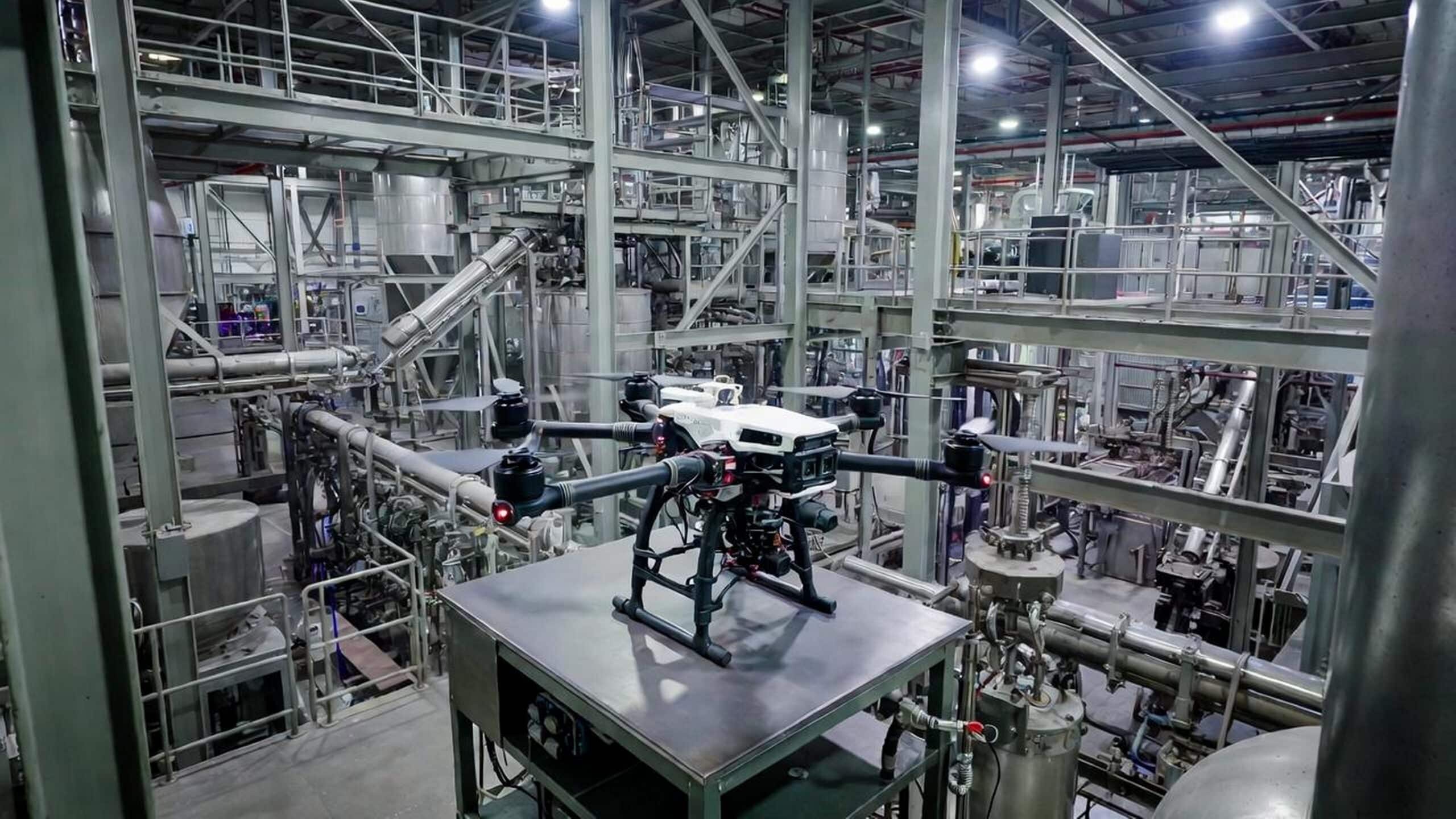
The emergence of the world’s first stable drone with a robotic arm—engineered with precision drive systems from Maxon—marks a revolutionary shift from passive aerial observation to active physical manipulation in hazardous environments.
Overcoming the Physical Barrier: True Aerial Manipulation
Equipping a flying multirotor drone with a multi-axis robotic manipulator has historically been an immense engineering hurdle.
Whenever a robotic arm extends, changes position, or exerts physical force against a structure, it shifts the center of gravity and introduces dynamic counter-torques. In conventional flight control systems, touching a solid wall or pressing an inspection sensor against a pipe causes the drone to become unstable, oscillate, and crash.
To solve this challenge, advanced robotics engineers designed an integrated stabilization and actuation ecosystem. By pairing multi-directional thrusters with high-precision, high-torque brushless DC motors, the aircraft actively compensates for aerodynamic recoil and contact forces in real time.
This enables the aerial manipulator to fly up to towering heights, securely press against steel or concrete surfaces with calibrated pressure, and execute fine-motor physical tasks while hovering with sub-millimeter stability.
Precision Drives in Harsh Environments: The Maxon Advantage
Operating in heavy industrial environments places brutal demands on electric drivetrains. Aggregate processing dust, thermal fluctuations near smelting and kiln operations, and high vibrations can quickly compromise standard commercial off-the-shelf electronics.
The robotic articulation and flight actuation systems rely on specialized Maxon brushless motors and precision gearheads to deliver:
- Extreme Power-to-Weight Ratios: Delivering maximum torque output while minimizing payload mass, maximizing flight duration and battery efficiency.
- Instantaneous Response Telemetry: Dynamic closed-loop controllers that instantly adjust motor torque to counteract physical resistance when the robotic arm contacts external structures.
- Industrial-Grade Environmental Sealing: Ruggedized components built to withstand particulate-heavy mining, chemical processing, and marine environments without mechanical degradation.
By leveraging precision drive technology that has powered Mars rovers and surgical robotics, aerial platforms are durable enough to operate reliably inside active heavy industrial plants.
Redefining High-Hazard Maintenance Workflows
Transitioning from passive aerial cameras to active robotic manipulation unlocks immediate practical applications across mining, quarrying, heavy civil infrastructure, and bulk material handling:
AERIAL ROBOTIC INDUSTRIAL APPLICATIONS
| Application Category | Operational Functions |
| Non-Destructive Testing (NDT) & Contact Probes | • Ultrasonic wall thickness measurement • Concrete delamination assessment |
| Physical Maintenance & Minor Remediation | • Debris clearance from critical junctions • High-reach optical sensor cleaning |
| Structural Integrity & Fastener Verification | • Critical bolt torque checks • Weld seam integrity logging |
Contact-Based Non-Destructive Testing (NDT)
Instead of building scaffolding across weeks to check wall thinning on high-pressure silos or refining vessels, an aerial manipulator can place ultrasonic thickness probes directly against steel plates, logging corrosion data in minutes without human exposure.
High-Voltage and Hazardous Zone Inspection
Substations, electrical distribution lines, and flare stacks present electrocution and thermal hazards. Drones equipped with insulated robotic arms can perform contact resistance checks or clear physical debris safely from a distance.
Rapid Emergency Assessment
Following seismic activity, severe weather, or structural rockfalls in open-pit quarries, aerial manipulators can sample unstable highwalls, test structural anchor bolts, and assess slope stability before sending ground crews into active zones.
The Leadership Shift: Integrating Advanced Automation on the Plant Floor
The rollout of aerial robotics reflects a broader structural evolution across the industrial landscape. Automation is no longer confined to stationary factory conveyor belts; it is becoming mobile, agile, and aerial.
For plant managers, reliability engineers, and safety directors, adopting robotic work platforms requires strong operational leadership:
- Upgrading Preventive Maintenance Protocols: Integrating live aerial robotic telemetry directly into Enterprise Resource Planning (ERP) and SCADA systems to move from scheduled maintenance to predictive reliability.
- Elevating Safety Metrics: Systematically eliminating “Working-at-Height” hazard exposures to reduce MSHA/OSHA reportables and lower corporate workers’ compensation overhead.
- Workforce Upskilling: Training maintenance technicians to transition from hazardous manual scaffolding operations into certified robotic pilots and automated systems operators.
The Resource Erectors Takeaway for Heavy Industry Leaders
Technological innovations such as Maxon-driven aerial manipulators demonstrate that the future of heavy industry lies at the intersection of operational efficiency and zero-harm workplace safety. Companies that invest in advanced automation protect their most valuable asset—their workforce—while streamlining operational uptime.
As heavy industry adopts high-tech automation, robotics, and advanced predictive maintenance systems, the demand for forward-thinking engineering leaders, operations directors, and maintenance superintendents has never been higher.
Ready to Lead the Next Generation of Industrial Innovation?
Whether you are an engineering professional ready to step into a cutting-edge operational leadership role or an employer scaling up your engineering and plant management teams, you need a recruiter who understands the technical future of heavy industry.
Take control of your trajectory. Browse active coast-to-coast openings on the Resource Erectors job board or submit your resume for general consideration to get your profile directly onto CEO Dan’s short list for premier industrial opportunities.
Time to Call Resource Erectors
At Resource Erectors, we specialize in connecting heavy civil, mining, aggregates, and industrial manufacturing producers with elite technical leaders who drive operational success.
- For Employers: When your organization is adopting advanced operational technology and needs experienced plant managers, maintenance directors, or reliability engineers, explore our recruitment services.
- For Professionals: When you are ready to elevate your career with industry-leading employers driving technological change, visit our contact page today.